
Insure Your Property Against Drought
May 20th, 2013This article is written by Jen Livsey, a Pasture Insurance Specialist for Texas AgFinance, about insuring your ranch against drought. A graduate of the masters program at the King Ranch Institute for Ranch Management, Jen is an expert in all areas related to ranch management.
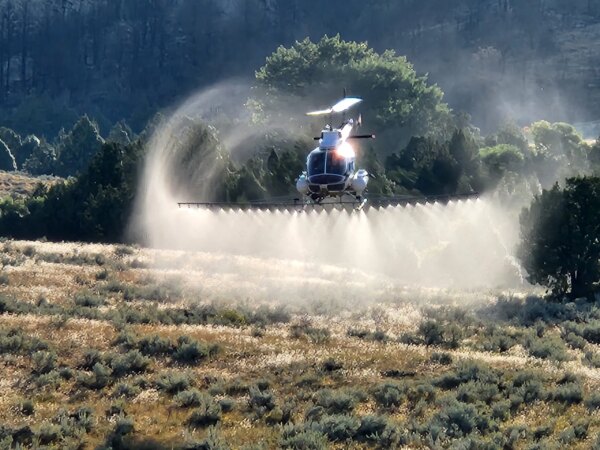
As drought continues to plague much of the United States, managing risk is top of mind for many owners and buyers of ranches. Pasture, Forage, and Rangeland (PRF) Insurance allows livestock and hay producers to insure their owned or leased property against drought. Often referred to as grass, rain, pasture, or drought insurance, PRF is a highly customizable product developed by the United States Department of Agriculture and sold by private agricultural insurance agents. PRF pays when rainfall or vegetative conditions in a given area during a selected time period are below a selected percentage of historic average conditions. PRF is customizable because a policy owner chooses which time periods to insure, how many acres they want to insure, what type (hay or pasture) of land they want to insure, and what percentage of average historic conditions they want to insure. These decisions and the geographic location determine the price of this insurance.
Two measurement systems, or indices, are used in the Western States (see map). In Rainfall Index states like Montana, the Dakotas, Texas, and most of Colorado, rainfall amounts for 12 x 12 mile grids are determined by the National Oceanic and Atmospheric Administration (NOAA) for 2-month intervals. In Vegetative Index states like New Mexico, Wyoming, Utah, and the western slope of Colorado, the United State Geological Survey (USGS) uses satellite imagery of 4.8 x 4.8 mile grids to measure plant growth over 3-month intervals. Neither index requires a policy holder to keep any records. Both indices express conditions as a percentage of historic average conditions. For instance, take a grid in Nebraska; if the number for January-February comes in at .568, NOAA has determined that grid received 56.8% of the precipitation it normally receives in January-February, based on records from 1948-present.
Prices and program rules are set by the Department of Agriculture, which means that service and analysis is what sets agents apart. A thorough analysis of a grid’s rainfall or vegetative history and variability, coupled with pricing data and a discussion about goals, budgets, and risk tolerance leads to the optimal policy for any given property. Not every agency has developed the software capable of this analysis. Jen Livsey, an agent with Texas AgFinance, used their software program to help nearly 150 policies realize an average 184% return on premium in 2012 (a 100% return = $2 paid out for every $1 of premium paid). If you are interested in learning more about PRF or would like a quote for your property, Jen can be reached at jen.livsey@texasagfinance.com or 719-659-2494.
Ranch broker
As the 107th National Western Stock Show closed out another year yesterday, we like to look back on this year’s stock show and how it supports 
Mirr Ranch Group is pleased to announce the sale of the
As Hubbard explains,
Denver, Colo. [December 13, 2012] – The
The
Since first entering the ranch brokerage business in 2005, I have had the good fortune to work on many deals involving conservation properties – ranches and tracts of land that have either been conserved with a conservation easement or have attributes that make them excellent candidates for conservation. Large tracts of unspoiled land, combined with a deep-seated landowner ethic of respect for the land, make the Rocky Mountain region one of the most creative and cutting-edge regions for land conservation in the United States.
On CBS This Morning, there was recently a great segment on land for sale within our US national parks. Mirr Ranch Group specializes in such properties, and currently has the following ranches for sale within these boundaries:
When it comes to our listings, Mirr Ranch Group works diligently across many areas and possible solutions to protect our landscapes, as well as ensure our clients’ interests are represented well.