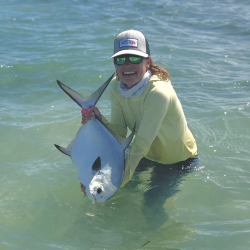
For 30 years, Casting for Recovery has supported women with breast cancer through the healing power of nature and fly fishing. This week, we revisit one of our favorite partners as Haley sits down with Stacey Benham, Director of Marketing and Communications, to discuss the organization’s mission and an exciting new initiative that uses storytelling to connect with women who may need support.
Casting for Recovery provides life-changing experiences on the water, and now, through the Jane Project—the story of a drift boat created to honor women and their journeys—that mission is reaching an even wider audience. Haley and Stacey discuss how the Jane Project is helping raise awareness, why women continue to shape the future of fly fishing, and how community, nature, and time on the water can be powerful tools for healing.
To learn more about Casting for Recovery, watch the Jane Project film, volunteer, donate, or apply for a retreat, visit castingforrecovery.org.
Topics
[0:00] A re-introduction to Casting for Recovery
[5:45] Introducing the Jane Project
[10:26] Women supporting women in fly fishing
[13:13] The healing power of water
[17:38] Early impact of the Jane Project
[19:17] How to get involved with Casting for Recovery
[22:19] Closing thoughts and what’s next…
Haley (00:06):
Welcome back to the Land Bulletin Podcast, where every other week we bring you experts in the field to impart their knowledge when it comes to the ranch and sporting property market, buying and selling advice, the latest best stewardship practices, as well as topics that impact landowners every day. I’m your host, Haley Mirr. Let’s jump in.
Welcome back to the Land Bulletin Podcast. I’m Haley Mirr and I’m your host. And today we’re bringing on someone from an organization that we partner with and that we care about deeply and a friend of ours, Stacy Benham. She is the director of marketing and communications at Casting for Recovery. We’ve had a couple of her coworkers and some incredible thought leaders from her organization on. So now we’re just honored to have the lady that connected all of us at the very beginning, Stacy. So thank you for coming on the show.
Stacey Benham (00:57):
Thanks for having me, Haley.
Haley (01:00):
And it was right before this. I was asking you if we’d had you on before, because I feel like you’re our point person for everything. So this is fun to have a conversation for all to hear now.
Stacey Benham (01:11):
It’s really nice to be a part of it. Thanks so much. You guys have been so great. And yeah, you had Susan Gates, our executive director, and Kara Armano, who is a volunteer and who runs the Western Slip Program on the podcast prior to me. So thanks. I’m honored to be here.
Haley (01:32):
And we’re bringing you on for a very special reason, but before we go into that initiative, I would love to discuss, for those listening who have not heard our previous conversations that we’ve been referencing, can you tell us a little bit about Casting for Recovery and what your involvement is?
Stacey Benham (01:49):
Yeah. I started as a volunteer for the Colorado program four years ago, and we have three retreats here at the North Fork Ranch in Shawnee, Colorado. And every weekend knocks my socks off. And with that, I kind of knocked on the door and Susan thankfully opened it up. And now I’m the director of marketing for this incredible organization that’s celebrating 30 years this year.
Haley (02:17):
Well, congratulations. That’s huge. 30 years.
Stacey Benham (02:20):
It’s huge.
Haley (02:22):
So I’d love to know about the demographic of people, women that tend to come to these retreats to fish and to volunteer. What does that typically look like and who are you seeing at the North Fork Ranch and other retreats?
Stacey Benham (02:41):
Well, our retreats are open to women of any stage, any age. So we have women as young as 20 and into their 90s, believe it or not. You’ll see in the news though that there’s a rising diagnosis among younger women and breast cancer is on the rise at younger ages they’re being diagnosed. So we see that in our retreats as well. And women under 50 are our fastest growing group and make up about a third of the attendance at all of our retreats. So we’re really trying to focus on that population, the resources and education and support that we provide to those populations that are attending our retreats. We’re also trying to expand access among women in rural communities. And we even have a retreat that’s two years old that’s geared for Alaska native women. So you can imagine the challenges of just getting medical care, like an annual mammogram when you live a float plane away from a hospital or let alone finding support in some of those regions.
Stacey Benham (03:54):
So retreats like that are really trying to address this critical gap in the breast care continuum. And so we’re really trying to hone our efforts there.
Haley (04:06):
That’s amazing. Well, it sounds like it started. I mean, I don’t even know. How did it start to where it is today?
Stacey Benham (04:13):
Oh, it’s a really good story. So the organization was started by two trailblazing women, Dr. Bonita Walton, who is a breast reconstructive surgeon. And her friend who’s a fly fishing guide, Gwen Perkins Bogart. They went fishing one day and while casting, Dr. Walton thought the gentle motion would be incredible physical therapy for her patients who had undergone radiation and reconstruction. So there really is a like, why fly fishing? It’s so much more. Being in nature is one part of it, but there’s a physical therapy element to it as well of that gentle motion. And I believe they even took it to an orthopedic surgeon to prove that, that would be really the physical therapy aspect really indeed works. So that’s what we see. But I mean, it’s really this incredible and unconventional catalyst to healing on so many levels. So it’s really cool. Well,
Haley (05:17):
I think that speaks to the water too. Two girlfriends going out and look what can be formed from good ideas and conversation on the river.
Stacey Benham (05:26):
Absolutely. Absolutely. No, it’s a really neat way of where they’ve started and how far they’ve come. Our organization has been really the model for a lot of fly fishing as therapy for a lot of other nonprofits too. So something we’re really proud of.
Haley (05:45):
And I’d love to now go on to the reason we have you here today. And something we’re really excited about is the Jane Project. Can you tell us a little bit about the initiative, how it started, and kind of what you guys are trying to do with that initiative?
Stacey Benham (06:02):
Yeah. It’s really exciting and really fun. It started out as a drift boat that lives in the Gallatin Valley in Montana. Most of it’s during the year. Most of its time is in the Gallatin Valley. And the boat is called Jane. It’s the second iteration. There was a pink drift boat named Judy that preceded the Jane boat. And with our 30th year, we wanted to kind of reinvigorate that idea. And on this boat, you can take it out in the Gallatin Valley with an incredible guy named Kara Tripp. And you can put a tribute to a woman that you love or who has inspired you on the boat. And it will live on and float on forever.
Haley (06:47):
I love that. And who’s Jane?
Stacey Benham (06:52):
Judy was named after someone’s mother. And Jane, we thought would be a great name to kind of universally represent women everywhere.
Haley (07:03):
I love that.
Stacey Benham (07:04):
We wanted to really recognize the largest growing group of our participants that are casting for recovery retreats, and that’s women under 50. And so the whole brand and vibe is a little bit more youthful and fun. And the image on the boat was designed by a young artist here in Colorado named Blakely Dunn. And she really injected some really cool feelings into the artwork. And the hand holding the fish has blue fingernails and it’s kind of hip and cool. And so we had a lot of fun with the brand and it’s getting a lot of really great feedback.
Haley (07:50):
That’s amazing. I would say I love the brand myself. I think it’s very fun to wear. So often you have branding initiatives and things like that and you don’t want to wear it because it just doesn’t speak to you, but I love it. I have a hat and I wear it all the time and it speaks to everybody, which is fun. So she did a great job designing that, I will say. And I didn’t notice that the fingernails were blue and now I’ll go back and look at it. That’s awesome. And I’d love to know too, we had the privilege of coming to Boulder and seeing a film about the project. Can you tell us a little bit about that film and why you guys decided a film would be an incredible way to talk about the Jane Project and bring it to an entirely different audience?
Haley (08:38):
I’d love to hear kind of how that started and the partners that you’ve created through that.
Stacey Benham (08:44):
Well, it’s a fun story. So we started with this boat idea and then Toby Bryston Pratt, who is the CEO of the F3T, has been a wonderful partner of ours and a huge steward of our mission. And his wife is actually named Jane and she is a survivor. When we told him that we were doing this drift boat and we had the idea for a short film, more like a commercial, like a really short idea, he said, “Let’s do it. Let’s put it in the tour and I think you can do it. I think you can make a really great story out of it.” And from there, we called Kara Armano, former guest of Billy and Bulletin Podcast. And she was the perfect fit to kind of really, I guess, be the focal point and foundation of this story and the mission behind Casting for Recovery.
Stacey Benham (09:41):
And from her perspective, she’s an incredible angler. She’s very well known in the fly fishing community. But I think what makes her so perfect is despite her incredible skill at fly fishing, the fact that she still got so much out of her time at a Casting for Recovery retreat as a survivor and really from there was inspired to become a volunteer and lead that Colorado Western Slope program. And she’s incredible. And so she tells the story from her lens. And I think it really embodies the universal healing that we all feel from being outside and also the importance of connection and community.
Haley (10:26):
I love that. And I will say, when comparing your film and the F3T to others, it was the only one with all women. And I will say I loved it. I was very proud. And I would love just to kind of focus why is the concept and the strong theme of your organization and the Jane Project and the film of women supporting women, why do you think that’s so important, especially in even the filming that we saw in a very male dominated industry? Why do you think that’s so important and why do you think it continues to be so important today?
Stacey Benham (11:11):
Well, I think inclusion is very important, especially in, as you mentioned, a real kind of male dominated sport and activity. But when we have greater access to these places and these waters and special places and sports, I think we ultimately all strive to make them better and preserve them and conserve them and drive everything forward. But it takes all of us.
Haley (11:45):
And I feel like, especially with recovering from all these survivors that are going through this, I feel like having that type of community and camaraderie of women who have experienced something similar, it’s just a different feeling than having a ton of. I love all the guys in my life, but it’s just a different thing, I feel like. And I felt that even with the Jane Project film that we saw the other night, it just feels like a different feeling that’s being a boat than some of those other films.
Stacey Benham (12:23):
Yeah. I agree. And I think that’s the importance of our retreats too. And oftentimes women share that they can’t share what they’re going through with their families and they don’t want to be a burden and share these things, but our retreats offer that sense of community as well and a place that they can share and be vulnerable and get the support and education and resources too that they need to cope and heal and improve their lives and how they walk through all these things. And I’m so glad that you love the film because I think it really does apply to whatever kind of stress and struggle we might be going through, how important connection is and getting outside is.
Haley (13:13):
Yeah. And I think the healing power of water and the healing space. I mean, even the other day when we were up there for one of your other initiatives that you guys are working on up at Reeder Creek Ranch, and I had just had a passing in the family and I wasn’t even fishing. And I was sitting on the river being like, “Man, this is all we need, just being up there.” So in your opinion, what is it about being on the river? I mean, you were a volunteer and now you work for casting. What is it about the healing water and how this has become a safe space for women and for you and the people that work for casting?
Stacey Benham (13:53):
Well, I think for me as an angler, it was a natural fit. I know what being on the water, like you mentioned, being out at Reeder Creek. And I mean, there were eagles there. That was really fantastic where we were. But just being out on the water, it’s incredibly meditative and casting a fly rod. For me, I don’t think of anything else. And before I was a volunteer for casting for recovery, I mean, that was so apparent for me of what fly fishing does to me and the therapy and meditation aspects that it gives me. And then I think just so pleased, I went to my first retreat and you see it and it’s like, oh my gosh, everybody feels this way. This is what’s happening. This is the magic. Everybody’s forgotten for these hours on the water, what they’re going through and what’s weighing heavily on their minds.
Stacey Benham (14:54):
And I think it’s so important getting out there and resetting and being present. And when you get to do it with lovely people who are kind of in the same boat, no pun intended, it’s really, really magical. So I think I’m always blown away. Every retreat that I go, the fact that everybody walks away with these feelings and our retreats have been called life changing for so many women. And
Stacey Benham (15:30):
It really is. I mean, and it’s life changing, I think, for the volunteers too, because you get to witness this and the hoots and hollers on the rivers and the hugs afterwards with people that they’ve met who now they can lean on forever. So it’s really neat.
Haley (15:45):
I know. I keep saying I didn’t want to come to a retreat. I wish these summers stopped being so busy. But they sound amazing. And I think – You’re going to come. I’m going to come. I’m going to move. I’m going to not move houses anymore and I’m just going to be available. But I think even taking a step further from the community and the healing, it’s probably some of these women have never set foot on rivers like this and been in these landscapes. And I feel like that too is just creating a sense of stewardship and responsibility and conservation beyond just even the healing aspect for some of these women that maybe it changes their appreciation of some of these rural spaces.
Stacey Benham (16:30):
Oh, absolutely. And we welcome women from all over the states. We have a lot of women in the Denver Metro area who have never been to a place like the North Fork Ranch ever. And it’s really neat. We greet everybody in the parking lot and walk them in. And it opens up into this lovely valley on the North Fork of the South Platte. And
(16:55):
Everyone just kind of takes it in on their walk to the lodge. And it’s just, you often hear in those first steps, I’m just so grateful to be here and I’m so excited. And it’s the best. Once it was pouring rain, pouring, it was a downpour. And I was like, oh boy, this is going to be rough. We’re going out with umbrellas and all these things and walking 10 women into the lodge, this was our stage four metastatic retreat. And not a single woman commented on the rain. They all said, “This is amazing. I’m so happy to be here.” And that really blew me away. So it’s so special. It’s pretty awesome.
Haley (17:38):
I see why you keep coming back. I see why you change your trajectory of your job to be with this group. It’s very special. Going back to the Jane Project, because you guys are working on it right now. I know you have a lot of other things kind of coming down the stretch, but what kind of impact are you already seeing from the Jane Project and the people that it’s touching?
Stacey Benham (18:02):
It’s been really neat to see. We released the trailer. The film launched in January and immediately we started getting a little bit more attention from women who, a lot of them have survivors and who this has impacted them and touched them in a way. I think that’s been unique. We’ve been out there for a long time, but something about this really spoke to a lot of women. And really we’re getting lots of trips booked with Kara and some of them, “I’m going to call an old friend and she’s going to fly out to Montana. I’m going to do this in honor of my mom who passed away. I’m going to do this in honor of my mom who’s just incredible.” And all sorts of different touch points throughout the campaign. And it’s been really, really lovely to see. We have a lot of our volunteers from across the country who are also jumping on board and taking a trip on the boat.
Stacey Benham (19:05):
So it’s been really neat and really lovely to see the messages and the impact that the organization has had across so many people across the country really.
Haley (19:17):
Yeah. I think people would. Our listeners tend to be very Western based, but I mean, you guys are all over the country, which is amazing. And for those listening who, North Fork Ranch, obviously the Colorado folks that we have who are on right now, but what are some other ways that people can get involved if they are being after this conversation like, “That sounds like something I want to be a part of or you’re a survivor or you’re going through treatment.” How can people get involved and support the mission that you guys are trying to do?
Stacey Benham (19:51):
We have 62 retreats across the country serving women from every state. 800 women a year. So if anyone would like to get involved, please share the application on castingforrecovery.org with someone who you think might benefit from attending. That’s number one. Spread the word. If you’re interested in volunteering, we are 100% fueled by volunteers at these programs, which is a pretty special and unique thing in nonprofits. So we have 1800 volunteers across the country fueling these retreats too, which is pretty spectacular. So volunteer. If you love fly fishing, we’re looking for fly fishing guides too, usually at these retreats. So yeah, there’s an application for those too. If you’re in the oncology field, we have volunteers that are in the oncology community and psych social workers in oncology at every retreat, which is also pretty unique. So yeah, spread the word.
Haley (21:04):
That’s beautiful.
Stacey Benham (21:06):
And donations also too!
Haley (21:10):
Let’s not forget nonprofits
Stacey Benham (21:14):
So yeah, we are fueled by lovely partners like Mirror. Thank you so much. And some great brands like Yeti and Mayfly and Bass Pro. We’ve got some really fantastic supporters behind the mission too, which is really special.
Haley (21:34):
Yeah. It speaks volumes to, I think, the brands and the partners that you guys have aligned with because one, it’s a powerhouse group. And two, this is such an important thing that affects so many different people in different ways. And I think that messaging and the mission, it’s just something that a lot of these people resonate with. So to Stacy’s point, if you want to get involved, if you want to learn more, they have a great website. Like we said, their branding is amazing and a lot of good resources. And just looking ahead, do you foresee after the Jane Project, other initiatives like this, storytelling, other ways to reach people in the future?
Stacey Benham (22:19):
Yeah. I mean, if I could and have the resources, I mean, almost every woman who walks through our doors has an incredible story. And we’re
(22:28):
Trying to showcase more and more of these stories because I think they resonate with a lot of women who maybe don’t know what steps to take and they’re facing a diagnosis that’s really scary and they don’t know what to do. And seven out of 10 of the women who attend our retreats have never been to a support group. So this is kind of the first time that they’re in a support setting. So I think if it was me, I would want to tell all the stories because there’s really some incredible, incredible women who come through. So I hope that we can still do a lot more video and film. And I think we’ll have a greater presence at some of these fly fishing community events too, which has been really, really wonderful.
Haley (23:24):
I would agree. I think, like I said, I think a lot of women in that room felt a sense of something when they saw that video smashed in between very intense, cool films, but it was like lots of great
Stacey Benham (23:37):
Drinking and a lot of grip and grins.
Haley (23:39):
Very cool. But it was like, oh, sometimes you just need a breather. Sometimes that’s the reason you go on the river is the breather, not this photo. Yeah.
Stacey Benham (23:49):
And it’s funny, kind of smack dab in the middle of these kind of really adrenaline fueled films. I was a little worried of how would this film be received that kind of takes it down a notch. And it’s very. Nate Dodge, our director, was incredible at the cinematic, I think, experience in capturing some of these wonderful places that we get to go and have these retreats. But it was really well received. And I’m very grateful that there was a place to tell this story. Thanks so much,
Haley (24:29):
I’m excited to see all the stories you guys tell and to continue to work with you all. Well, I’m excited to see where you guys go, and I’m proud to be partners with you all and to be even affiliated in some capacity with what you guys do. So thank you for letting us be a part of the journey. And for those who have not seen the Jane Project or want to see the video, if you go on the F3T website, you can see all of the different times, but you can also access that through Casting for Recovery’s website. So it’s an incredible film. Some of the other ones are great too, but like I said, it’s an incredible breather and it’s a reminder of why we go out there. So thank you, Stacy, for all that you do. I love your brain. I love where you take Casting for Recovery.
Haley (25:16):
So I’m sure we’ll be chatting again soon, but thank you for coming on the show today.
Stacey Benham (25:20):
Thank you, Haley. You and your team are the best. We’re so appreciative of all the support.
Haley (25:25):
Awesome. Well, good luck with everything and we’ll talk soon.
Thanks for joining us today. To learn more about the ranch real estate market or our ranch marketing process, make sure to subscribe to our newsletter on our website at myrranchgroup.com or give us a call at 303-623-4545. See you next time.