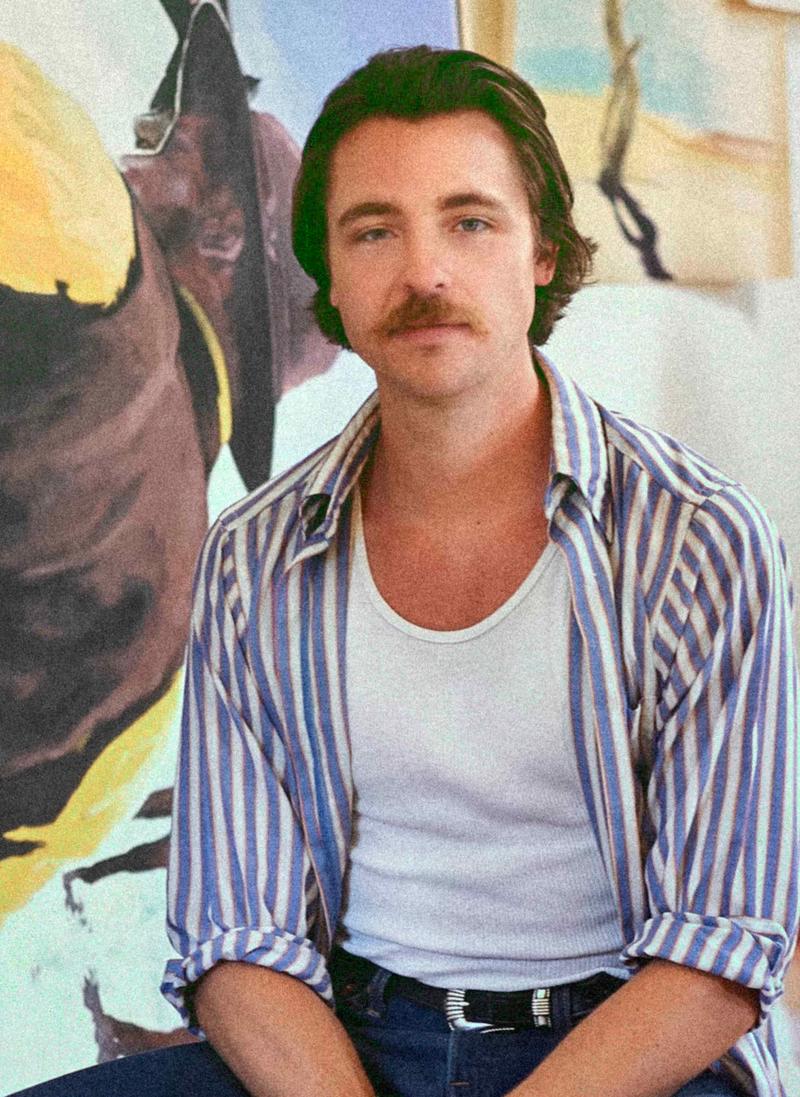
In this special episode, Haley sits down with GL Richardson, the featured artist for this year’s Young Guns of the Coors Western Art Show. From his East Coast beginnings in Virginia to his transformative experience as a ranch hand in New Mexico, GL shares how the West has inspired his artistic journey. Discover the stories behind his latest works, his creative process, and his thoughts on the evolving landscape of Western art. This is a must-listen for art lovers, ranch enthusiasts, and anyone captivated by the spirit of the American West.
Topics
[0:00] Introduction to GL Richardson
[2:51] Life on the Ranch
[4:59] Early Paintings and Ranch Inspiration
[7:33] Stylistic Evolution
[11:15] GL’s Creative Process
[14:37] Featured Artwork
[21:28] The Future of Western Art
[25:14] Closing Thoughts and Resources
Haley Mirr (00:00):
Hi out there. It’s Haley with the Land Bulletin podcast. Today is a very special episode. We recorded this episode with GL Richardson, the featured artist for the Young Guns of the Coors Western a few weeks ago, and just wanted to repurpose this for you all because the content is important. The Arts of the West and connecting people with the West and its culture are a big part of the education of the next generation. So I hope you all enjoy my conversation with GL Richardson for the Young Gun Show at the Coors Western Art Show. Thanks so much.
Welcome everybody. It’s Haley Mirr here. I’m on the Committee of the Young Guns of the Coors Western, and we are having our featured artists on today to talk about the works that he’s going to be bringing to the show, a little bit about his past experience, what got him started. So without further ado, here’s GL Richardson.
GL Richardson (01:04):
Hi.
Haley Mirr (01:05):
Thanks for coming on the show, G. We just wanted to have our committee, the people that are coming to the show, our patrons really get to know you a little bit better before the show so that when they’re looking at their work, they can really know about the inspiration and what went behind it. So before we get started, I’d love to know your background. You live in Santa Fe now, but what brought you to the west and what inspired you to start painting what you’re painting today?
GL Richardson (01:33):
Sure. So it’s sort of a long journey here I’d say, but I started in Richmond, Virginia. That’s where I was born. I had an early interest in art and sort of excelled there and felt it was a strong suit of mine. And then just in trying to be a practical person, decided not to pursue fine art, not without a little encouragement from my folks to try to figure out something else, but it ended up being advertised. I went into advertising. I was an art director, lots of school, six years of school, ended up in San Francisco and then from there realized that I’d wasted six years and a lot of money going to school for advertising because the industry did not jive with me and who I am. So I left and went out to a ranch in New Mexico and basically found my voice there artistically and just I’d say even beyond that I learned a lot about myself and what I want out of life. I was out there for the year and two months working as a ranch hand and it was life changing.
Haley Mirr (02:51):
I love that. So you got your hands dirty and you saw what it means to be the west, and I think that’s what’s so cool about your art is it’s actually inspired by work you’ve done and being around cowboys and cowgirls and ranch hands and the whole thing. So that’s really cool. What size ranch was it? Was it like a big cattle ranch or what type of property was it?
GL Richardson (03:15):
Yeah, it was a pretty large cattle ranch. You think it’s massive and then which it is, but then you start realizing what massive really is 300,000 acres. Okay. Yeah. S one wasn’t that, but not incredibly far off.
Haley Mirr (03:39):
That’s awesome.
GL Richardson (03:40):
Yeah. Yep.
Haley Mirr (03:42):
So did you start painting when you were working on the ranch or did this come kind of after?
GL Richardson (03:47):
So I did one painting when I was in San Francisco, still working at the ad agency and it was of cowboys and like I said earlier, I did have a very early interest in life and art and so I kind of fell back on that skillset, got re-energized in the whole thing, the whole creative outlet, which is painting. But then I look at what I made, I’m really happy with it, my first painting and 10 years probably, and it’s cowboys and it just didn’t sit right with me that I was painting something that I didn’t know. I didn’t feel very authentic, so I was kind of at an impasse and didn’t paint anything, didn’t paint anything, painted something else and then never finished it. Ended up painting maybe three or four paintings when I was out on the ranch. Then there was a fork in the road. I was given the option to continue working to level up within the company that I was working for Ranchlands, do the apprenticeship or figure out whatever else I was going to do. And so I took that chance to say if I was 55 and never tried this art thing, I think I’d be really disappointed.
Haley Mirr (04:59):
Well, I didn’t know that you were working with Ranchlands. They do an amazing job of integrating art and artists into their operations. That’s awesome.
GL Richardson (05:09):
Absolutely. Yeah, it’s a huge part of what they do and they somehow have just surrounded themselves or artists have flocked to them probably more like, and yeah, there’s art is sort of baked in. They have a lot of fantastic pieces in their personal collection and Duke, duke is an artist in his own right with words. So it was weird to leave that whole thing and be like, I’m resetting and then go out to a ranch in the middle of nowhere and find that it was actually incredibly supportive of that creativity that I longed for. That was a surprise.
Haley Mirr (05:49):
Yeah, that’s very special. And there have been a lot of other Coors Western artists that have had residency at Ranchland. So did some of that kind of interaction with maybe some of those artists inspire you to look into Coors Western or did that happen by just happenstance?
GL Richardson (06:07):
Well, like I said, I only painted a couple paintings when I was at the ranch and I focused on what the day to day and it really is almost the everyday job. So it wasn’t a huge part of my life and I wouldn’t say that I had any interaction with the Ranchlands artists when I was an intern with them, partly because the New Mexico rancher was fairly new in their program of ranches and off the beaten path, so we were pretty isolated. I was out there during Covid as well,
Haley Mirr (06:41):
So Oh
GL Richardson (06:43):
Wow. That was another thing. But when I left and decided to pursue painting, duke immediately put me in contact with Duke Beardsley and we hopped on a call probably two months into meeting up in Santa Fe, which it was wild to have an artist that established willing to talk to this kid who has no experience and doesn’t know what the hell he is doing and just be an open book. Lots of words of wisdom and guidance that call. I still think back on some of the things we talked about in that first call. Yeah, I mean at this point now I’ve talked with many times we’re going to meet for the first time at Kohlers Westland and talked to Jill Suku and he a number of others.
Haley Mirr (07:32):
It feels very full circle that you and Duke are the featured artists for Coors, Western and Yun. So I love that story. I would love to know, has your kind of style changed over time as an artist? Have you gotten a lot of influence from different kind of eras of painting and things like that? How has your style come to be what it is today?
GL Richardson (07:54):
That’s a tough one, but I guess I’ll start with sort of how I was applying paint. Early on I was using spray paint a lot actually and stencils and also, so it was oils per paint applied with stencils and then sort of some melting in between there and it had kind of a street art feel to it. I’d say. It’s funny to look back and look at the paintings directly after coming off of actually working on a ranch and not really see the authenticity there. That works, to me feels removed from a lot of the things that are gladed in through the years now. It’s almost like by stepping away and just thinking back on the time spent out there and the things that we saw and did that they began to resonate more and mean more and mean more to me I should say, and feel like I needed to incorporate into my work.
GL Richardson (08:52):
So yeah, you’ll look back at the past work and not particularly see my work anymore. It’s pretty far. So nowadays I try to paint things that really happen on ranches still with a twist to it because impossible to get rid of our past and the things that inspired us and that we kind of grew and learned from. So I’d say that my work still, this past show I did in July, I had some floating elements on it that were detached from reality elements kind of just fading away like ghostly. Yeah. So it’s not completely grounded in reality, but the things that people are doing are generally speaking more what you see when you’re on a ranch, what you do when you’re on a ranch and trying to find the meanings in there that are baked in things that unless you really sit down and decide to overthink it, maybe it’s a very simple thing, but maybe it’s got some meanings tuck away in there that you can pull out.
Haley Mirr (09:58):
And do you ever revisit either the property you worked on or other ranches to continue kind of garnering that subject matter that you’re painting from day to day
GL Richardson (10:09):
As often as possible,
Haley Mirr (10:11):
And
GL Richardson (10:12):
We still have friends within Ranchlands and outside at this point now and go visit them and ride with them and work with them. A lot of them are from our era when we were working for Ranch Lands, they also started or were very early in their apprenticeship. So it is funny to be, the paths diverge in what they’re doing, what we’re doing, but it’s so easy to, they come to my art shows, plug right in, we go to their ranches, plug right in. It’s really fun to actually answer your question, I do pull a lot of inspiration from those trips
Haley Mirr (10:50):
And then I’d love to know because a lot of new collectors, especially at Young Guns who are starting to understand what western art is, the meaning behind it, but also the process. What is your process from Blank Canvas to finished work? It probably changes from painting to painting, but would love to know a little bit about how you think of your art and how you get to a finished piece.
GL Richardson (11:15):
One of the things that was really holding me back in the day when I was torn am I going to pursue art or not was I’m not an artist that can just sit down in front of a blank sheet of paper and paint something from my imagination or draw something from my imagination and have it be this incredible thing that’s just not me. I am much better when I have photo references and I was like, oh well that’s not an artist. And I’ve come to realize that no, that’s sort of the thing, whether it be a live model or working off of imagery, it seems to me now that I’ve been in the art world for a while, full years, that most artists work off of some kind of reference material that’s just par for the course. So that held me back for a long time and when young artists asked me or young people ask me, I always try to tell ’em that it’s totally fine to use reference material.
GL Richardson (12:16):
It’s like a light bulb goes off. So sorry, that was a long tangent to say find my reference material, whether it be old photos or screen grabs and movies or my personal film photography when I’m going out to those ranches, I take a camera with me all the time and snap photos and there’s just something about film photography, like a developed film that has an authenticity view to it, like a human quality to it that I like working off of. You take the sound picture with your phone and it looks like it was taken on a phone, whereas you take a photo on a film camera and look at it, it looks like it’s how it was in your eye. So I work off of I collage from all those places and then I’ll sometimes sketch, sometimes not. I’ve recently, I’ve always wanted to be an artist that sketches and really works it out, but for some reason it’s like the first go.
GL Richardson (13:13):
That’s when, for lack of a better word, the magic happens. And so I’ve just started attacking pieces when I feel that they’re ready to go and sometimes it works, sometimes it doesn’t. But that’s sort of it. A lot of it is jumping off point is an idea, something that I’ve been thinking about and maybe writing about. So it’s like image gathering, reference imagery gathering combined with just things that I kind of want to say with the work and things that I think resonate with people. Human truths that you can pull out of western culture and western life.
Haley Mirr (13:55):
It is, it’s storytelling. It’s always what drawn me to western art, especially just living in Colorado and working with ranchers and landscapes like that. I think it’s just an incredible way for people to digest the culture without necessarily working on a ranch, but it helps people appreciate that lifestyle that does exist out there.
GL Richardson (14:15):
Completely agree.
Haley Mirr (14:16):
I’d love to know, you talked about the visual representations that you have in front of you when you’re starting your work and the inspiration that you get from ranches. Can you tell us a little bit about the pieces that you’ll be bringing to the Young Gun Show and what has inspired those and why you chose the images that you’ll be bringing?
GL Richardson (14:36):
Alright, so I think that one is pork in the road, which maybe that’s why I chose that phrasing earlier when I was talking about do I stay within the ranching world and pursue this, make this my future or move up to Santa Fe with Anna and we go that direction. Art and Anna’s a landscape architect, he used this figure with his back turned to you. You can’t tell if he’s turning towards you or turning away from you. There’s two horses up on the hillside like horizon line. I wanted them to be a visual metaphor for a fork in the road. Which horse are you going to get on? And that be, that’s your decision. This next one’s name Lookout. I like to frame things I guess not unusual elements, but just maybe things that aren’t as typical. I really like Windows and I really like doors. This piece is, you can tell that, well my 95-year-old grandmother was able to tell it was a window, so I hope that I was like, when she said it looks like a car window, I was like, okay, it’s reading. Right,
Haley Mirr (15:43):
Perfect.
GL Richardson (15:46):
It’s somebody looking through a car window. You’re also looking through a car window at this rider on a hill. It kind of ties back to what I was talking about with my work. It’s not always explicitly grounded in reality. It’s the rider’s ghost-like and sort of fitting away kind of like ens, shrouded and mist a little bit. Yeah, so that piece, I’d say the thinking behind it and why I incorporated the car window is just most people are like, oh, you’re out there riding horses every day and that would be a dream. Most times you’re doing checks in the truck or a dirt bike, something that doesn’t wear your horses out, use them for moving cattle. So just trying to incorporate to the reality that automobiles are heavily used, but there’s also, it’s both right. Horses are used a ton and so are cars. So I don’t dunno.
GL Richardson (16:35):
I liked that idea. Lunan weightless is a rider kind of riding down into an arroyo and moving some cattle up and out of it. The horse’s feet aren’t necessarily connected to the ground they are. It’s very blurred and I wanted to touch on that feeling that when you’re in a car and you go over a hill and your stomach just kind of rises up up and you feel weightless for half a second, you can get that feeling on the horse too. That piece isn’t some big concept, it’s just that feeling of that freedom of riding a horse and kind of plummeting down into an arroyo and how awesome that feels.
Haley Mirr (17:15):
I love that.
GL Richardson (17:17):
The next one is artists of the branding and this one, it’s in some ways a self-portrait. Other ways. I’m not the only artist out here and artist, whether you’re actually on site painting or not, you have brought your kind of toolbox with you just in how you’re seeing things. So I have this person walking towards this group of folks that are branding. You can tell because there’s branding corrals and then their silhouettes. One guy has his arm up his rope. The artist or the figure that’s walking towards them is sort of the predominant thing in the image room he’s got behind him. He’s holding them as he is walking their paintbrushes. I painted paintbrushes literally, but when I’m at a branding, I’m taking it all in and whether it be with my eyes or with camera, it’s working like I’m working. Even though when I go out there and brand with them, I don’t like to just stand on the sidelines.
GL Richardson (18:20):
I’m in there ground crew. I don’t get up on the horse and load. But yeah, I’ll run ground crew all day and I carry a disposable camera with me since it’s so likely to get destroyed at brandings. And also, yeah, I can pull it out so quickly and snap a picture from cool angles. So yeah, artists that are branding is, it’s not specifically about me, it resonates with me from my experience. I’m sure other artists could talk about that better than I’m talking about it. The next one is called First Iron and it’s also from a branding from the angle of the person holding the back hooves of a calf. You see the person which is Duke from Ranchlands, he’s applying the iron. There’s a lot of smoke kind of rising up and then there’s a figure kind of obscure through that smoke and the first brand that’s applied is usually the hottest because it’s just been sitting there heating up till the first calf is dragged in and so it creates the most smoke.
GL Richardson (19:20):
I’m really happy with this piece color and composition wise, it feels real to me. It is what you see when you’re running ground crew at a branding. That one might be my favorite, but I’m also toing between this last one here, it’s called Brothers also branding. So three out of these six are from brandings. I guess it just speaks to my spring summer. This year I went to four different brandings, Colorado, Texas, New Mexico was out there with ’em and doing it. And so yeah, three out of the six are from brandings. This one is also one. And the images that I worked off of on this one are kind of from all of them, but the main subjects are from the frying pan down in Texas. And there were some year old steers that hadn’t gotten castrated and I think they might’ve also missed their brand. And so there were like 80 of them or something and they were huge. It would take an entire swarm, like a dog pile to get ’em down. We got there on day two, it was three days of branding and on the ride out that morning to the corrals, it’s like, well, how are you guys doing that? And one of the guys, Dylan, he’s like, oh, we have a system.
GL Richardson (20:35):
And then the first one gets roped and I got to see the system, which was basically just dog pile the hell out of it and hoped he did it down and everybody come out on stage. That big toenail is still regrowing from that. We got stomped on.
Haley Mirr (20:56):
Yeah, I feel like that’s just the part of being on a ranch, you lose things.
GL Richardson (21:03):
Exactly. Yeah, I was happy. It was just the nail. So anyways, that scene after the steer’s been taken down by that dog pile, my girlfriend Anna has said that it calm somehow, even though it is this fairly hectic situation. And yeah, I’m also really happy with that. These got to paint some of my good buddies too, so that’s always fun.
Haley Mirr (21:28):
Well, I’m so excited to see all of these in person. I mean we’re going to see photos of them in a little bit, but it’s cool to hear too the inspiration because so often we go to shows and obviously art evokes a feeling in each of us in different ways and certain art appeals to certain people and not to others, but to hear the background and the emotion that went into some of these, I think it just helps kind of these younger Western art collectors understand the importance of the story too. Art evokes a feeling, but it’s also good to know the background. So I appreciate you going through all this. Before I let you go, GI would love to know where you see the direction of Western art going since being on the committee for Young Guns and since going to the Coors Art Show since I was a kid, to see how Western art has changed over time, but the stories and the sources of inspiration remain the same. Where do you see a western art going in the next couple of years?
GL Richardson (22:35):
Oh man. I don’t know if I’m the person to answer that question, but it is tough because a lot of your exposure these days comes through social media. So I know that I need to get out and see more work throughout the west, visit more museums and galleries to really get a total understanding and be able to answer that effectively. But the things change, but they stay the same, right, within everything. But within ranching it’s really nice that sometimes you’re still using a rope to catch an animal
GL Richardson (23:15):
You are catching. That’s just one example of hundreds that I’ve seen. It’s just somehow it’s the best. The old way is still the best way. That doesn’t, I don’t think, expand for grazing practices. I love what absu with grazing practices and ranch management seeing changes there is fantastic. So yeah, to answer your question, my art itself, I think that people are going to continue to paint what they see and the Western film genre seems to be making a comeback. So I think we’re going to continue seeing a lot of hollywoodish depictions of the western world, cowboy life, but also at the same time these things, they haven’t changed all that much. And so you’re going to see people representing it authentically and with a mix of that kind of heroism or romanticism that exists within Hollywood. I think that that’s all part of it. When you’re riding a horse, we feel pretty badass, so it’s part of it.
GL Richardson (24:16):
You can’t pru that. There’s definitely artists excited to see every time they post on Instagram. Brett Allen Johnson is a fantastic artist. GW Dean, fantastic artist in person. What a guy. I’ve gotten to meet him and he’s a good one. Jed Smith, he’s my age and I loved what he’s doing. I’d love to have there be a Frt shoulder type person show up in the art world. I show back up in the art world. He’s one of my favorite artists of all time, especially within the western art world. Maybe somebody will figure that out. He had a certain magic that, I don’t know if it’s replicable. Matt McCormick out of la, he’s doing kind of the city take the kind of romanticized take on the west, but I really like what he does. Mark Maori is a great, in our time, a living. Great. I don’t know where it’s going, but I’m excited.
Haley Mirr (25:13):
Well, it’s just,
GL Richardson (25:14):
Yeah, there’s so many.
Haley Mirr (25:16):
It is cool. It’s like people continue to move more and more to the cities, but the fact that this kind of medium and this inspiration of the west still exists and will continue to exist for generations to come is huge. And that’s just one of the biggest reasons young Guns it exists, is to really bring the West and its culture to the people of not just Denver, but of this state. Because there’s a lot of people moving here that don’t really understand what the West really is and what it means to a lot of people. So it’s just cool to have artists, young artists like you and people up and coming, all the people you just mentioned, just to kind of represent that in different mediums. So I’m just so excited for the show. I’m so excited to meet you in person and for you to meet Duke in person for the first time, I think that’s awesome. I work with Duke’s brother and I just love the Beardsley, so you’ll have a great, great meeting with him. But I just want to thank you again, GL, for taking the time. We’ll be posting this on our social media and our website and things like that just so people get to know you better. And if you guys have questions, be sure to follow GL on his Instagram. He’s got a lot of cool work coming up there. You can search GL Richardson, but it’s intern. ETGL is the Instagram handle if you’re looking for it. Oh,
GL Richardson (26:40):
Thanks for the project, Haleye.
Haley Mirr (26:42):
Yeah, yeah. And I’m so excited to meet you and thank you for being our featured artist this year. We’re excited to have you.
GL Richardson (26:49):
Oh, I’m honored. And yeah, thank you. I can’t wait to meet you either. I’m going to be up there. It’s going to be a great time. I’m sure. I’m really excited to see you all.
Haley Mirr (26:58):
See you soon. Bye. GL. Bye.