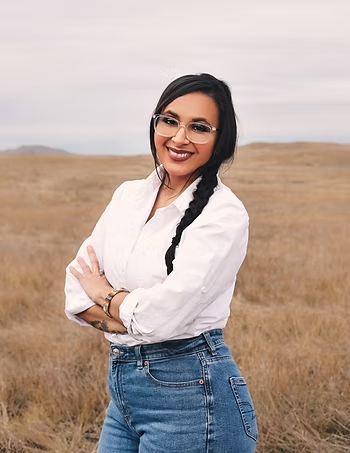
What does it take to build a stronger future for Native agriculture? Dawn LeBeau, Senior Program Officer at Akiptan, joins Haley to discuss the organization’s work providing capital, education, and resources to Native agricultural producers across Indian Country.
From patient capital and land financing to youth programs, financial literacy, succession planning, and traditional stewardship practices, Dawn shares how Akiptan is helping producers build successful operations while strengthening their connections to land, community, and future generations.
Topics
[0:00] Intro: Why Akiptan Was Created
[4:01] Financing Challenges for Native Ranchers
[8:23] Investing in the Next Generation
[15:21] Balancing Traditional Knowledge and Innovation
[19:31] Akiptan’s Five-Year Vision
[24:10] Finding Hope in the Next Generation
[27:12] Resources for Producers and Landowners
Haley (00:06):
Welcome back to the Land Bulletin Podcast, where every other week we bring you experts in the field to impart their knowledge when it comes to the ranch and sporting property market, buying and selling advice, the latest best stewardship practices, as well as topics that impact landowners every day. I’m your host, Haley Mirr. Let’s jump in.
Welcome back to the Land Bulletin Podcast. I’m Haley Mirr. I’m your host. And today we’re going to be looking at a different group that we haven’t had the experience of interviewing today. We’ll be interviewing Dawn LeBeau. She is the senior program officer at Akiptan, a organization that helps with native-led CDFIs focused on agriculture and food systems in Indian country. So without further ado, welcome Dawn to our show. I can’t wait to hear more about what you guys are doing up there. So thank you. Welcome to the show.
Dawn LeBeau (00:57):
Hi, thank you. Glad to be here with you today.
Haley (01:00):
Well, before we get into what Akiptan is and what you guys are doing for native ranchers, I’d love to know your background and how you came to your role over there at the organization.
Dawn LeBeau (01:12):
Yeah, of course. So my name is Dawn LeBeau. I am a enrolled member of the Cheyenne River Lakota Nation in South Dakota. My background in agriculture, it stems generations back. I have images of my great, great, great grandmother sitting in a cornfield husking corn and gathering corn. On top of that, my dad was a cow-calf operator and we helped him out tremendously in his goal of having an operation. And as a Lakota indigenous woman, our ties to the land, they just are continuous. And so we know that the land gives to us, we give back to the land and there’s lots of reciprocity.
Haley (02:03):
That’s beautiful. So you’re up in South Dakota. Is Akiptan all over the West or is it just in that region? And what led to the creation of it? I guess that’s more of a two-part question, but I’d love to know who started it and what created this need for an organization like that.
Dawn LeBeau (02:23):
Yeah, so we’re a certified native CDFI located in Eagleview, South Dakota on the Cheyenne River Sioux Tribe Reservation. We are a nationwide CDFI. We serve agriculture producers across the country, and we were founded underneath the Inter-Tribal Ag Council. IAC, the Inter-Tribal Ag Council, is a decade old organization. Their mission is to connect native producers with the resources that they need to be successful in their operation. And the leadership at the time was constantly seeing producers being met with an unjust inequitable finance system that was setting our producers up for a lifetime of debt. And so they decided to create Akiptan and they wanted Akiptan to be dedicated to financing native ag producers throughout Indian country. We are founded on the principles of lender security and producer prosperity, patient capital versus extractive capital, innovative lending and relationship-based lending, and that’s reflected in our name. Akiptan is the Lakota word for doing something together or in a joint effort as a partnership.
(03:50):
And we have a team of 16. A big majority of us are located here in South Dakota, but we have folks in other states as well.
Haley (03:59):
That’s amazing. And when looking at, because when people are purchasing ranches or there’s a lot of different organizations and programs out there that help ranchers, what is the biggest challenge that I would say native ranchers are facing when trying to create their operation, sustain their operation and then continue their operation?
Dawn LeBeau (04:23):
Right. So going back to why we were founded, agriculture financing, it often puts our producers in that extractive never-ending debt cycle, and that’s not working in Indian country. And we stand behind the belief that patient capital is the way to do financing. We have longer loan terms and up to five years of interest only period products. So we’re leaving more profits in our borrower’s pockets. We know that that extractive capital leads to those extractive practices, which is also extracting from the land, their quality of life and things like that. So we have our two different innovative lending options. There’s the interest only repayment option, which is the five years interest only, and then it goes to blended. And then we have a more traditional style that has longer terms, lower interest rates, and we want to be able to offer our producers all of the financial information that they need to be a successful borrower.
(05:40):
It’s not just looking at that portion, but we’re also doing other things on our programmatic side, which includes initiatives around workshops, webinars, financial curriculums, programs for succession planning, youth initiatives so that the students have access to understanding the finances of operation at a younger age.
Haley (06:06):
Well, that’s huge. Literacy and help where needed is always big. Why is agriculture, and you’ve said it even in your intro, it’s your multi-generational families that have been involved in agriculture. Why is it such an integral part in tribal economies and communities?
Dawn LeBeau (06:25):
Yeah, so we have land stewards dated back since time immemorial, and so we take care of the land, the land takes care of us. We’ll always need to feed ourselves. And so we did a market study back in 2022, and we know that financing these operations is a huge part in that. And so continuing to help producers to be successful in their operations and knowing exactly what each community needs is going to be a vital part of everything that we do here at Akiptan. And I also want to name, there is a document by the Native American Agriculture Fund. It’s called Re-imagining Food Economies. That document, it’s showing different industries and how those industries can be successful in the future and what the dollar looks like on that. We’ll always have to feed ourselves, and that’s what it comes down to is having the knowledge that you need to be successful in your operation.
Haley (07:28):
That’s huge. And to your point, knowing the land and taking care of the land, the stewardship piece, and I believe that natives were the first kind of people to know how to do that the right way. And now we’re kind of all learning together as we go, and I think imparting knowledge that we used to have and what used to work and integrating that into some of these modern ways of improving the land and improving overall operations. But I would love to know more about the programming and the education that you were referring to earlier. Why is it so important to start Education Young? And then what sort of opportunities is Akiptan offering to the youth who might be interested in a career in agriculture and continuing this tradition of taking care of the land?
Dawn LeBeau (08:19):
Yeah. So our very first loan was to youth, which is exciting. And I began here about six years ago, and we believe that education is the foundation of accessing capital. And so over the years, we curated and refined numerous different products and services designed to educate the youth on financial literacy, financial preparedness, financial readiness, whatever you want to call it, business planning, coaching, risk mitigation, all in that effort to assist them with access to capital. So we do quite a different variety of youth programming. They’re very intentional. So we have what we call our Okichaye scholarship. This scholarship supports Native American high school students as they go off into college, whether that’s vo-tech, vet tech, a university. So we offer them a scholarship to help them with that portion of getting that education. And then we have a summer youth internship program where they learn our youth curriculum, which is available on our website.
(09:31):
We have seven different modules in there. They learn about cash flow sheets, balance sheets, personal budgeting, and then they develop a agriculture business plan. And then within that program, we’re very intentional about how many students participate in that. We know just hearing the word financial literacy can be just kind of like, what is that? Or oh, whoa. There’s a relationship with money that needs to be just cared for a little bit better. And so we keep our cohorts of the internships small so we can engage with them and we can have them feel comfortable and ask questions and challenge their own thought process or learn alongside one another because our students are coming from different regions. We have folks down in Arizona, up here in South Dakota, all the way across from the Pacific Northwest to Wisconsin. And so the landscapes are different. The irrigation systems are different.
(10:39):
And so they’re learning alongside their peers about what things look like in their community, and it’s very, very exciting. So we have that program. We have our Youth Awoju program. This is a garden program. It’s a short one-month cohort where students are learning about business plan development and also learning about soil health and food preparation, food safety, things like that. And then we have our agriculture business plan competition. And this year we had four finalists in there. We had a compost company, a protein bite company, that’s not what it was called, but that was the model, hydroponic garden system and then a diesel repair shop. And so we’re very proud of them and how they come up with these ideas and they built out their cash flow system and they’re getting a really good start to understanding what it would look like to start a business in their rural community.
(11:40):
They’re leaning on their mentors and asking them questions. And so that’s one of our other youth programs to help them prepare. And then we also have a youth equity grant for our youth that apply for lending with us. It’s a program that we have with our adult clients, and we just recently added it to the youth clientele as well. So they get additional set of grant money to help them to build their assets.
Haley (12:08):
Wow, that’s amazing. You guys are doing a lot of different programs to create some of this innovation and things that the future and our youth are dependent on. So I’d love to know what’s the feedback been from some of these youth programs or kids wanting to get more involved in agriculture? Have you seen since even starting six years ago kind of a shift or a good reaction from a lot of these youths?
Dawn LeBeau (12:32):
Oh, absolutely. One of the students said, “You’re going to learn a lot of valuable life skills that you’re going to use for the rest of your life.” And when he was referencing the curriculum that we went through, he said it’s pretty much as good as a college course in business. Another intern said that they love the hands-on experience working closely with the loan side here at Akiptan. It allowed them to learn and develop a deeper understanding of the financial process for ag producers. They also got an opportunity to attend one of the conferences and that helped them to understand all of the KPIs and the data entry and why that’s important to tell our story and to support producers. As far as our scholarship, we get a lot of feedback and we have some blogs on our website, but the students, they inspire me every year.
(13:35):
They are so eager to give back to their community. A lot of them are just like, “I want to go off and I want to get this degree and I want to bring it home and I want to help my community.” And so that’s really inspiring. And then we just started the garden program online and the feedback with that was just like, “I have a better understanding of a business plan now or I have better understanding of soil now.” And we really encourage them to ask their community questions, ask their family questions. Like I said, our cohorts and things are kind of small for our internship program so that they can be prepared on how to ask their mentors questions. In our curriculum book, there’s a little prompting list in there showing them like, “Here’s how you start the conversation. Here’s some questions you can ask them because we know a lot of the knowledge that we carry is from the older generations.” And so having those conversations is very important.
(14:37):
And the feedback from students has been overall good. I attended a conference last summer outside of this community and there was a youth student there and I said, “Oh my gosh, hi, how are you?” And we greeted each other and she said, “This is Dawn. She’s the one that taught us about financial literacy for agriculture.” And that’s always really exciting. And we let the students know these are your peers that are going to stay in the native ag space and you guys are going to crop paths 20 years down the road. You’re going to be doing all the work we’re doing down the road. And so it’s really exciting.
Haley (15:17):
That’s awesome. I’d love to know, and you mentioned it a little bit about the tribal traditional knowledge of agriculture and practices. How do you guys help people balance the innovative practices? Even you were talking about the finalists of the youth programs with hydroponic solutions and things like that. How do you guys balance some of those more traditional practices with the innovative ones?
Dawn LeBeau (15:42):
Yeah. I want to name, we just did our impact report for the past year and the label was for producers by producers. Majority of the folks on our team are either in an operation, had an operation, their family has an operation. And so Akiptan being created with producers at the forefront of our mind and knowing the need of capital. We also understand that a lot of our producers are already doing practices to take care of the land. They’re in some sort of conservation program. If they’re not in the conservation program, they’re already practicing it or continuing what they have been doing. Our producers, they’re very intentional about giving back to the land so that the land can take care of them. They’ve been doing things like controlled burns, companion planting, rotational grazing. So they’re very intentional about how much water they can hold for their operations.
(16:50):
And so just goes back to that for producers by producers, it’s innately in a lot of our producers already. So if you want to invest in the health, then you have to think about the whole ecosystem.
Haley (17:08):
Yeah, I would agree. And it’s kind of what we’ve run into a lot of our landowners and our ranchers is there’s a lot of these different practices that help, but the ethos kind of remains the same no matter when you’re looking at or what time period is just taking care of land and making sure it can be sustained. So how does it keep done beyond the youth programs and so the innovative practices we were talking about, how does it keep done support landowners in other ways?
Dawn LeBeau (17:37):
Yeah, we have our land mortgage and down payment assistance program. So we’ve had this lending product since 2019. We provide our producers with a tool of how to purchase land or finance that down payment portion. So anyone over the age of 18 years of age can apply for that land loan fund. The down payment assistance has up to a 15-year repayment period and the full land mortgage product, it has up to 30 years of repayment period. And we offer a lot of technical assistance with all of our lending products. And so that comes in the form of our financial literacy tools, which are available on our website. We’re excited to share. It was earlier last year that we successfully closed on our first mortgage towards trust land. And so our loan officers did a wonderful job at that and worked very closely with another native CDFI here in our local town to help support that closing.
(18:45):
And so they’ve been doing trust land mortgages for a while now. And so we are just getting into it, even though we’ve had that product on our service list for quite a few years now. We’re excited to join the class of folks that have done it.
Haley (19:02):
That’s amazing. Are there other things on the horizon that you’re really excited about? It sounds like the mortgage, that’s a big hurdle to kind of jump over and be able to be successful at, so congratulations. Are there other programs you guys are working on that you’re excited about?
Dawn LeBeau (19:18):
We just started the Youth Awoju program. We’ve had a cohort for adult gardeners for quite a few years, but we just did our five-year strategic plan. It’s a four direction type of plan. So we want to solidify our visibility and our voice, deepen our support for producers, grow our capacity through people and purpose, and then enhance our internal system so that we can support long-term growth here at Akiptan. I’m so thankful for our team. We are a small team of 16. This work wasn’t done overnight. We just met, was it last fall to do this strategic plan? We had a team of, I think four when we did our very first strategic plan and we had some big goals back then. And this year we were able to sit down with all 16 of us and look at what we really would like to do.
(20:20):
And so our impact report is on our website and you can read a little bit more about what the next five years are going to look like, but of course at the forefront of that is supporting our producers. We have a wonderful succession planning program that is something that our producers asked for in our market study back in 2022. There was 31 recommendations in that market study, a lot of it around accessing capital, accessing knowledge, succession planning efforts. And so we take those and we meet with our team and how can we help our producers? What can we create? So we created this program called the UNYAYA Succession Planning Grant Program where our producers that are clients get a $7,000 grant to help support them with life insurance or retirement. And that has been a very well-rounded program that our producers really appreciate. So lots of things on the horizon and I think our team is ready to put our boots on and get to work.
Haley (21:30):
Yeah. You have a mighty team of 16 who are, it sounds like you guys have a really incredible vision of the future. In your opinion, what would an ideal and thriving native food economy look like when you look at the big picture and what you guys are trying to create and the individuals that you’re connecting with on a daily basis?
Dawn LeBeau (21:51):
Right. So in our strategic plan last year, we sat down and we thought about our vision. We have a mission statement and our mission statement is to provide capital, tools and prosperity, but we sat down and we thought about this intentionally. And like I said, a lot of our team are producers themselves or have family members that are. So what we wrote up for our vision statement, and I’ll just read it verbatim, Akiptan envisions a future where native producers across Indian country have unrestricted equitable access to capital tools and knowledge that support their growth and prosperity and our systems reflecting traditional values, responsiveness to need, and drive innovation in food and agriculture while filling financial gaps and restoring native stewardship with the land, the food and economies.
Haley (22:54):
That’s awesome. Yeah. You’re like that sums it up.
Dawn LeBeau (22:58):
Well, a lot of people have been part of Strategic’s plans and there’s a lot of words, a lot of thoughts, a lot of great wonderful things that go into all those words I just read off. Yeah, big time. Under one of them, there’s a lot of depth. So in our start plan, we have identified all of our goals for the next five years and we have a wonderful plan ahead of us and it’s something we meet on once a month and then we’re doing the work. So we want to be able to help producers get access to all these things that they’re asking for and tell their story and support them along the way.
Haley (23:42):
That’s awesome. And what gives you personally hope for the future? What have you seen in even the last six years of working here and in the generational changes that you’ve seen from your grandparents to your dad to today? What are some of the things that give you hope for the future of agriculture, especially when it comes to native producers?
Dawn LeBeau (24:02):
Oh gosh, lots of things. I think the first thing that comes to mind is being able to support the youth and seeing them have access to knowledge that I didn’t have access to at a younger age. Obviously we have access to things when we’re working out there with our parents and in our community, and then actually putting pen to paper is another piece of it. And so being able to support them with our youth initiatives definitely gives me hope because we know that they’re going to be the ones stewarding the land down the road. And if they can have access to even more knowledge and in a fun and creative way so they can get excited about it, that gives me hope. They have a lot of wonderful ideas and they’re excited about things. And so being able to support them in a meaningful, intentional way is exciting for me, but also my team excites me.
(25:03):
Seeing all the hard work that our loan officers do and to date, I just updated our portfolio today. Let’s see here. So our loan team has deployed 57 million in the past six, almost seven years since we have joined the native CDFI folks. And so that gives me hope knowing that producers are having access to a different type of capital that helps them to grow their operation. And also there’s one saying that we have around here, it’s like, I’m going to get it all wrong. I know I am, but producers get a day off. Whether the snow is coming down and it’s negative 40 degrees and the wind is blowing or it’s raining and they’re trying to fix machinery in the middle of a hot day, they still have to go to work. And so we keep that at the forefront of our minds and the work that we do.
(26:06):
And so I’m not even going to attempt to say it how we say it, but they have no days off. And so we want to put that kind of work into what we do here at Akiptan, and I think our team does a really good job at that. And the other part I’ll close with is we have wonderful partners. Everybody that we have partnered with up to this point has been consistent in supporting each other and kind of moving on the same track to the goals that we have for the people in our community. And that’s really exciting and that gives me hope as well.
Haley (26:43):
Well, on this pod, what we’re really trying to do is just to show producers and ranchers and future landowners the resources and education that is available to them because like you said, they don’t get any days off, so it’s our responsibility to help them where we can. So it’s incredible to speak with you and to hear about what you guys are doing at Akiptan. It’s an incredible organization and it’s probably something a lot of other organizations can start to emulate because you guys have a lot of incredible programming and education that I think is imperative for the future generation and for stewardship in general. So thank you for being on the show, Don, and taking time out of your very busy day. I know you have a lot going on to talk to our listeners about the incredible work you guys are doing. Thanks for joining us today.
(27:33):
To learn more about the ranch real estate market or our ranch marketing process, make sure to subscribe to our newsletter on our website at myrrranchgroup.com or give us a call at 303-623-4545. See you next time.