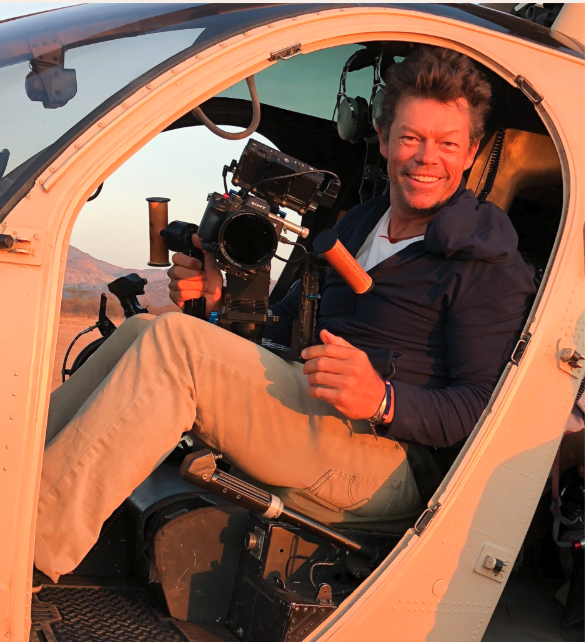
What happens when you dedicate 20 years to following a river from its headwaters to the sea? For Peter McBride, it has meant gaining an eye-opening perspective on water, the West, and the people who work and live on Western lands. A filmmaker, author, and photographer who grew up on a Colorado ranch, Peter joins Haley to discuss the decades he’s spent documenting the Colorado River and the changing landscapes, communities, and ecosystems that depend on it.
Through the power of storytelling, Peter hopes to break through apathy and inspire greater stewardship of our water and Western lands. As irrigation ditches run dry and decades of footage reveal an alarming trend in the Colorado River Delta, it’s more important than ever to document these changes and bring greater awareness to drought, conservation, and the collaboration needed to protect the West’s most vital resource.
Topics
[00:06] Peter McBride: a Career and Passion for the West
[06:19] Following the Colorado River From Source to Sea
[11:19] Watching Western Rivers Run Dry
[15:21] The Power of Showing Instead of Telling
[19:52] What Happens When Communities Work Together
[25:55] How Everyone Can Become Part of the Solution
[31:22] Learning From the People Who Know the Land
[36:33] Finding “Earned Hope” in Restoration
[41:28] Inside Witness to Water
[48:24] Keeping Water in the River for the Next Generation
Haley (00:06):
Welcome back to the Land Bulletin Podcast, where every other week we bring you experts in the field to impart their knowledge when it comes to the ranch and sporting property market, buying and selling advice, the latest best stewardship practices, as well as topics that impact landowners every day. I’m your host, Haley Mirr. Let’s jump in.
Welcome back to the Land Bulletin Podcast. I’m Haley Mirr, and today we’re going to be talking about how storytelling can save land stewardship and the future of the Colorado River and other parts of the West that matter. Helping us out today is Peter McBride. Pete is an incredible photographer. He has five books under his belt and he’s working on kind of bringing a new one out there right now, and we’re going to talk about all of that. But without getting into the details yet, I’d love to welcome you, Pete, to the show.
(00:53):
Thank you for taking time out of your very busy schedule to join us today.
Peter McBride (00:58):
Thanks for having me, Haley. It’s fun to see you and sorry we’re not in person.
Haley (01:02):
I know. Well, one time. We’ll meet up, but I would love for the people listening, before we talk about your books, can you tell us a little bit about yourself, how you got started and why you got interested in conservation photography?
Peter McBride (01:17):
Sure. Yeah, my name’s Pete McBride. Some people call me Pedro. Comes from my grandfather who grew up in Guatemala. He was a coffee grower. I grew up in the Rocky Mountains of Colorado and I grew up on a cattle ranch. My family still lives there. I don’t live there now, but I spend time on it. We don’t have our own cattle, but we still run cattle on it and we put up grass hay. We’ve got some old water rights. We have some junior water rights we can get into, what that means exactly for those that don’t know.
(01:56):
After college, I went back east to college. Where I grew up at the time was pretty small and I went back east and I went and worked for a newspaper called High Country News as an intern, as a writer. And they’re still around today, amazingly. I did a story where I made some. I was actually branding. We were branding, our family was branding and I photographed it and wrote a little article about spring branding, no big deal, used to it. And the editors loved the photos more than the story. I hadn’t even written the story yet, but it kind of planted the seed in my head and I was like, “Wow, photography. Interesting. I never thought about that one.” Then I dug into it a little bit and realized you could actually back in the day make a living. And so that was back in the ’90s.
(02:44):
So I’ve spent three decades being a visual storyteller. I became a filmmaker and then I’ve gone on to write books and I’ve spent the last three decades working for National Geographic, Smithsonian outside, the old outside, what it used to be, and a bunch of different print publications. And I’ve sold documentaries to Disney+ and then I’ve gone on to be a public speaker. So I’ve spoken for a lot of different stages from. I got invited to speak at the World Economic Forum. That was a trip.
Haley (03:21):
Yeah. What was that like?
Peter McBride (03:22):
It was beautiful, high security. I felt like a total peon. I mean, there was all these big alt estates and CEOs of companies and I was just a little guy talking about water in the West and you could tell how important people were by how many people were in their entourage. My entourage was zero.
Haley (03:42):
But I’d say the subject matter was one of the more important ones of the
Peter McBride (03:45):
People that were there. I wish we could get that message to some of those leaders. Water is, I would say, our most valuable limited resource on this planet, and I think ranchers know that better than anybody. I grew up irrigating, chasing water, a lot of flood irrigation using shovel. We moved to some gravity fed sprinkler systems. We’re at 8,000 feet, so we only get one crop, but we had to turn off one of our junior ditches last year. We’re very much on the front lines of this water issue. It’s not a downstream issue, which when I started documenting water, it seemed like that was the mindset, but it’s rippled all the way up here to the Rockies. Anyway, I’ll back up. After working at High Country News, I got in and did some crazy adventure expedition stories for National Geographic. I went to Everest, I went to Antarctica.
(04:47):
I got deported from a country in Africa, Djibouti.
Haley (04:51):
We’ll talk about that later.
Peter McBride (04:54):
I did a lot of high adrenaline expedition stuff, and then I came home and was a little burned out. My dad’s a pilot. He’s still with us today. He’s 88. His name’s John. I call him Pablo. He’s awesome. My mom’s still with him. She’s just turned 87. I now fly his plane, but he took me out for a flight and he encouraged me to look at water. Normally, when your dad tells you to do something, you’re like, “Yeah, whatever, dad.”
Haley (05:28):
I do that every day.
Peter McBride (05:30):
Yeah, yeah. And this one I was like, “Yeah, maybe you’re right.” And so that was 20 years ago, and I started following water around our ranch and where it comes from at the top of the Colorado River watershed. And then I ended up following the river source to sea. I learned that the mighty Colorado that goes through seven states, two countries, supplies the drinking water in our faucets to 40 million Americans. It irrigates roughly five and a half million acres of farmland, includes our ranch. And so it grows America’s salad bowl, I like to say. It’s a big engine on the economic GDP for the country. It’s like over 10%. You add it all up with.
(06:19):
Anyway, that was 20 years ago. My dad suggested that idea and he kind of thought I’d stick around home and do a story around water at home. It ended up being that I would spend the next 20 years documenting the Colorado River on all fronts. So I’ve basically floated the whole river or most of it to the sea. It doesn’t reach the sea anymore, so I’ve walked the Delta the last hundred mile. I’ve walked the entire length of the Grand Canyon. Story for National Geographic to highlight national parks and challenges with water and resources and loving places to death. I’ve done trips in just about every tributary from the Yampa to the Gila, to the Roaring Fork River, to the Eagle. I
Haley (07:04):
Love the Gila.
Peter McBride (07:06):
A lot of aerial pictures I did with my dad, probably a lot of ranches you guys have been involved with in the Colorado, Utah region. Even though I’m mostly a visual storyteller, I just wrote this book, which was a fun experience. So it’s all predominantly words. There’s a few photos and it’s like 215 pages of all my stories talking about Colorado River. It’s called Witness to Water, but it includes these personal stories about my dad and how he nudged me to look at something bigger than another adventure. Could you tell a story about a resource and how valuable it is? It’s a bit of a full circle story because it brings me downstream and all the way back home.
Haley (07:56):
I love that. And from a visual perspective, what was the first thing that drew you to taking photos of these river corridors throughout the west? What drew you to that?
Peter McBride (08:10):
I think flying with my dad initially gave me that bird’s eye perspective. This was pre-drones. This was 2008, so the whole social media thing wasn’t like we weren’t getting showered with images. The aerial perspective gave me a chance to show the Colorado River in a little different way, where we’d been, where we haven’t been, where the straws are, where it’s wild, where it’s running low. I really became enamored with that idea and then it reconnected me and my dad. So we had a fun father-son buddy trip flying. I mean, flying a small plane through the Rocky Mountains, it sounds scary. It can be dangerous, but with a good pilot and being safe and smart, it’s extraordinary. It’s spectacular.
Haley (09:06):
I think that’s just beautiful. I think you’ve probably seen how much it’s changed too in even just the last 10 years about some of these corridors not even being there anymore or you see the outlines of what they used to be. Can you tell us a little bit about that change and maybe where you’ve seen the most impact when going back to some of these places you’ve photographed in the past? I’ll
Peter McBride (09:30):
Start at the end of the river because when I got to the end, I’d heard about it. There’s a guy named Aldo Leopold who wrote about the Delta and he took a canoe through there a hundred years ago, talked about this river being braided and everywhere and nowhere, so much water. When I went there in 2008, it was cracked earth, bone dust, apocalyptic dry. So that river stopped in 1998. So the Colorado flowed to the sea for six million years with big spring floods, stopped entirely, not a drop naturally since 1998. There’s been some conservation pulse flows that I’ve documented and paddled on, which is we can get into what we can do and the hope.
(10:20):
When I got there, that was just across the border from Yuma, Arizona. That’s like the lettuce capital of the world, if you haven’t been there. Pretty much in December, that’s where 95% of our lettuce comes from. From that point south, I walked. I carried my pack raft, my pack, which seems silly in hindsight because I thought I would paddle and I never saw water. A lot of fresh drinking water, so it was a really heavy load. I think it kind of woke me up to being like, “Wow, this is a real deal. This water thing ain’t no joke.” So that’s where it started. That kind of got the river’s claws into my heart and soul, so to speak. And then since then, I mean, I’ve seen water shortages and springs run dry in the Grand Canyon. I did a pack raft trip down the Yampa River.
(11:19):
The river ran dry, basically. It ran down to nine CFS. That’s what a lot of irrigation ditches run at. So I had to drag my boat through 50 miles of the Yampa River. That’s a free-flowing river that should be flowing higher levels. It’s probably running dry pretty soon here. The Hilo River, that nearly ran dry when I was on it.
(11:46):
I’ve seen a lot of these. I’ve seen Lake Powell. Lake Powell, for those that don’t know, is behind Glen Canyon Dam. That’s the second largest reservoir in America. It’s above Grand Canyon. Below Grand Canyon is Lake Mead, America’s largest reservoir. Lake Powell is now down to 23% full. It went to 22 a couple years ago. So I’ve seen tributaries in the Escalante. Coincidentally that my father walked up in 1968 before it flooded. It took
(12:17):
25 years to fill that reservoir. So I got to compare his footage to mine and actually stand in very similar spots. Landscape’s coming back. A lot of the archeology was washed away, sadly. And then lastly, I’ll say that on our ranch last summer we got a call, so I went up with my brother and we actually had to turn our irrigation ditch off. We have a junior right, it’s 1945, someone downstreamed with a senior right getting water. They said, “We need our water,” and so we had to turn ours off. “Hay Meadow, I’ve irrigated and we’ve hayed my whole life and probably since the 80s, had to let it run dry for three weeks in June. It’s supposed to be high water in June.
Haley (13:09):
I was going to say June’s early.
Peter McBride (13:12):
And we closed the head gate and pulled the apron, and I remember looking at the river, and I actually went and had to save a fish that was in the ditch because there seemed to be more water in the ditch. So I put a fish back in the creek, brook trout. And I remember looking at the creek and I was just like, “Holy cows, that thing is a trickle.” And when I was a boy, I remember driving my three-wheeler. My dad got me a three-wheeler back when they were still legal. They’re totally bangs or dangerous now, I guess, because I, of course, tipped mine over at age 11, crossing the river like a dumb ass.
(13:56):
I remember watching, I got to shore and I watched my three-wheeler float away. So that is May, 40 years ago, reference to last year’s May where there was maybe two inches of water. So to see that difference in my lifetime is alarming, and it’s not just a one-off. This is the third decade. Consistent. Yeah, it’s consistent. I try to use story and visuals to remind people that this is really important and we need to figure out how to work together. I’ve seen plenty of people do that, and I’ve seen plenty of ranchers work with environmentalists and recreationists and tribal communities, try to keep our creeks wet because that’s the challenge.
Haley (14:54):
It seems like sometimes from a visual perspective, that type of storytelling might hit people’s emotions a little bit more so than the news or those kinds of narrative. Have you found that that speaks to people a little bit more when they can see, “Oh, this is visually changing at a rate we can’t stop?” Have you found that from your conversations with people along the way?
Peter McBride (15:21):
I mean, I think I get invited to talk in front of a lot of different groups of all different political stripes, and I don’t ever try to preach to them. I just show them what I’ve seen. And so show versus tell, and I think that helps a little bit. I mean, it can get political. It’s the saying whiskeys for drinking and water’s for fighting. That’s a great
Haley (15:50):
That’s a great saying. I love that.
Peter McBride (15:52):
I think it’s still happening and it’s going to happen. But I do think that having visual storytelling that doesn’t have an agenda, my agenda’s just been to document literally what I call my backyard river and show it over time, show both positive and negative change. Don’t fixate on one or the other. I mean, it’s been kind of negative lately and we need to figure out some solutions and managers need to come together. They’re not, sadly. I wrote an article suggesting they all get in a boat and float down the river together and get off when they figure it out. That’s great.
Haley (16:39):
Once it’s not unnavigable, maybe they’re like, “Oh, maybe this isn’t the best situation.”
Peter McBride (16:46):
I think that’s not the best classroom.
Haley (16:48):
Yeah, I would say so. That’s what we’ve even found with what we do. It’s like, man, people, if they just float down the river, they go on an ATV, they all become kids and they all become even playing field once you’re outside and you’re seeing what’s happening to these places firsthand. Well, to kind of look at the positive, looking at your backyard river, have you seen examples of stewardship, conservation, or neighbors coming together to combat this and try to affect change when it comes to rivers?
Peter McBride (17:21):
Yeah, I’ve seen it. Our family put a conservation easement on our ranch in Colorado, so that was cool that our family was able to come together and do that. That didn’t necessarily raise the creek bed, but I mean, that was one concept. You guys work in that a lot, I’m sure. But I’ve seen some amazing stories, some are related directly to water, some less so. I’ll give you a couple. The Yampa River, I was floating with a friend of mine, Len Nesifer, he’s a Navajo storyteller, and the river was basically dropping out under our boats, and we were afraid that we’d have to stop paddling and walk the last section. We’d already dragged the boats for 45 miles, and then we’re like, “Well, we might just have to pack them up entirely.” And that night I went to bed and I listened to these great horn owls hooting back and forth in this remote kind of beautiful section river with very little water, and I was photographing making time lapses, and I noticed the river level was starting to come up, and I was like, “That’s interesting.” And then the next morning, there was all of 70 CFS.
(18:40):
It had come up from 10, and so we paddled out and it was beautiful and a classic river trip. I was like, “Wow, that was cool. I wonder what hell happened.” Went back and I reached out to some contacts and a fish biologist who had been working on the humpback chub, a threatened species of native fish that spawns in the Yampa, she told me it was a cool story. She’d put out the word and she’d talked to the city of Craig upstream. They’d talked to some ranchers just west of Steamboat. They’d talked to one of the power companies, and all of them coordinated so the river wouldn’t run dry, and they were like, “Oh, I can wait two days to take my water, and if I could take it on Friday and you take yours on next Wednesday.” And so sure enough, it wasn’t mandated, it was just an organic thing.
(19:37):
And that can happen, and that may have been a rare example, but it was a cool example. You got
Haley (19:45):
To go from 10 to 70 in an evening just because of neighbors agreeing to do something.
Peter McBride (19:52):
They closed their head gate down or didn’t pull their power to cool off the power plant or whatever. And so that was a collaborative work across all sectors, which I was like, “Okay, there’s some hope there.” A term I like is earned hope where people just keep working really hard, they never give up. I saw a Native American family down in the Grand Canyon protest and fight for water protection around the Grand Canyon. They’re worried about uranium mining. Uranium could be a bridge fuel for the future, but it leaves a really toxic radioactive signature if it gets in our water system. I’ve seen it pollute streams in the Grand Canyon. It’s so bad you can’t drink it or you’re advised not going to touch it. I filmed this nine-year-old a supine girl and her mother protesting, and I though, “Well, that’ll never go anywhere.” Two years ago at the age of 17, she was invited to introduce a new national monument to protect the landscape for water protection around the Grand Canyon, a million acres.
(20:58):
Wow. The existing uranium mine, which is active today, Pinyon Plain Mine, was grandfathered in, so they’re still active. There’s discussion, debate over that and how that’s done, but anything going forward in the future was done by a mother-daughter team that grew up with a dirt floor and no running water. We were able to coordinate 13 tribes and state government, federal government, and so the power of a few voices. So that was another example. There’s more I’ve seen like that, and it’s just trying to come to the table and communicate without knives out can get a lot done.
Haley (21:49):
Yeah, it can be hard to do, but like you said, if you just get people to have a day on the river or see what you’re taking photos of and how it’s impacting people, I mean, that’s all you need is to start that narrative, start that dialogue. When you look at a broader, it sounds like you’ve traveled the world, you’ve photographed a ton, and now you find yourself really focusing on the water and the Colorado River and these things that are happening in the West. I know it’s hard to compare it, but how do you compare it to some of the global issues that you see? How is this different? How does this compare? What has drawn you to really focusing on this when there’s so many things that are happening in the world?
Peter McBride (22:31):
Yeah, it’s a good question. I’ve been privileged to work on all seven continents. This recent book, actually, I compare the Ganges River, it’s called Mother Ganges Maganga, and it flows through Northern India. It drains the Himalaya, basically India, Nepal, and Bhutan. It’s the exact same length as the Colorado, and I did a Source to Sea on that trip for National Geographic years ago, and I measured water quality, and that river supplies drinking water for half a billion people. Wow. It’s a little bigger, same length as the Colorado, but it starts out at 23,000 feet versus 14, so a little higher, a little bigger flows.
Haley (23:16):
I was going to say.
Peter McBride (23:18):
It’s own length, and amazingly, it’s actually run dry and stretches too. So this is happening all over the place, and in India, they revere the river like a goddess or a god, they call it a goddess, or Lord Shiva, the river flowed through the locks of Lord Shiva’s hair is the saying. So they come and pray to the river, and I talk about how they kind of give it an open hug daily, but maybe they love it to death a little bit too much, where we seem to turn our backs on our rivers and we just take them for granted. So we love them, but we sort of forget that water comes from rivers, not from the tap. Right,
Haley (24:11):
And it’s like someone will figure it out. It’ll always be there. It’s like this, to your point, just take it for granted.
Peter McBride (24:20):
So we think food comes from the grocery, water comes from the tap, and we’re learning the hard way that that’s not really the case. And so I’ve seen that around the world. So all these major rivers and tributaries that keep them alive, so from Ganges to the Nile, to the Amazon, I’ve done work on all of them, they all are telling similar stories, just a different scale than the Colorado. The Mississippi has the same issues. Even on the East Coast where they’re on the eastern side of the hundredth meridian where they get all the moisture over there, they get all the rain generally, water tables are dropping over there too. So it is that one resource that. I think the most important thing is ranchers already are very connected to it on a daily basis. Maybe not the rivers per se, but at least their irrigation networks, but people should be aware that their water supplies, whether in a city or a town or a ranch, is coming most likely from a river or a watershed that connects to that river.
(25:32):
And so just a quick example, like Denver, 50% of its drinking water comes from the Colorado River, Las Vegas, 90%. Los Angeles, 50%. Phoenix, 40%. Tucson, 100%.
(25:50):
I can just go on and on. It’s all coming from one river, and most people just don’t know that.
Haley (25:55):
So for those who maybe don’t connect with it on a daily basis, like ranchers who understand, “Hey, these flows are dependent on these things and they work with it on a daily basis,” if there’s someone who cares about it and wants to get involved and doesn’t know how, because they help with, for instance, we haven’t watered our lawn yet this summer, so those little things, but how do people get involved in policy? How do they learn about water policy? What are these maybe positive things that are happening across the west and different localized changes that you’re seeing that are working?
Peter McBride (26:32):
Yeah, I mean, a lawn is a great place to start. So figure out what’s in your lawn, how big is it? Is it relatively. If you’re not using sections of it and you’re growing a species of grass that doesn’t even belong in that part of the country where you are, say Kentucky Bluegrass and you live in Utah, you can replant a more drought tolerant grass, water in the night, don’t water in the heat of day, time it, don’t water all the time. And if you don’t need sections of lawn, do it. Vegas has championed. It started in Denver actually, but you can smartscape your front yard. So zeroscape is what some call it. You tear out the thirsty crop, you put in more desert-friendly shrubs and people have done it well. They actually have people come by as drive-bys that want to see the amazing desert oasis and they use a fraction of water.
(27:34):
So the front yard is a good starting spot to become aware.
(27:41):
So if you’re getting a water bill that has this tiered effect, that’s just your local town trying to remind you, once you go over this point, we’re going to charge you through the nose. That’s for good reason because we just don’t have enough water and that’s a good mindful one. There are other places in the ag community, and we all like to think of the agricultural world as mom and pop out on a cattle ranch somewhere, but a lot of them are industrial agricultural lands, and there’s big swaths on the Colorado River that are growing 10 to 15 cuttings of alfalfa year round, just grinding it out, pumping water from 3,000 feet down, and they’re not even keeping it in America. They’re selling it to Saudi Arabia and China, so they’re exporting water in the form of forage overseas. These facilities, I think, a lot of them are actually owned by foreign companies, Saudi Arabia.
(28:41):
I have nothing against Saudi Arabia, but I just think when we’re in a situation of extreme drought, we should be more mindful of how we’re doing our agriculture, and we should try to keep that water more concentrated. That amount of water going to alfalfa is about a quarter of the Colorado River.
Haley (29:01):
Wow, I didn’t know that
Peter McBride (29:03):
Yeah, that could sustain the entire historic delta. Some people say, “Well, who cares about the delta?” That’s just water flowing into the sea, but those deltas kind of recharge water tables, but also are instrumental in keeping the fly zones for birds that travel transcontinentally. There’s this choke point right there at the end of the Colorado River where they all kind of pass through, think of it as the pinch of the hourglass. These are the birds that come keep insects in control or help pollinate. They’re kind of the messengers that keep our whole system running. They’re the natural insecticides if you are a farmer. They’re beautiful and cool, but they help keep the balance. I think ranchers know that if you only have one crop and no wildlife and Nothing around you. It’s a tough system to stay alive. At least that’s what I’ve seen and learned.
Haley (30:07):
I would agree.
Peter McBride (30:08):
Biodiversity is the immune system, it’s immune system for the planet, which is the immune system for us and our food supply.
Haley (30:20):
I would agree. And I think ranchers, we’re seeing it even in some of the people we’ve connected to land with changing even what they’ve been planting. To your point, when you were talking about alfalfa, it’s really interesting to watch how ranchers have changed even what they grow to be more drought talent or to get creative with how they graze. There’s a lot of interesting things, I think, because to your point, the majority of the water that is being used is for agriculture. So how do we integrate some of that into our policy? But it seems to us that a lot of ranchers are starting to get creative and change their tune with some of that. Maybe it’s not all of the, to your point, commercialized industries, but it seems like for the most part, ranchers are, I think, at the forefront of some of this change.
(31:11):
So we’re working on our lawns, but ranchers are working on a much larger scale and trying to improve it.
Haley (31:17):
Which is interesting.
Peter McBride (31:22):
I mean, ranching ag is the big straw on a lot of these rivers. And the tricky thing is they’ve been doing a lot on their own for years, and they hate it when the person straight out of college from the city comes and tells them what to do.
Haley (31:40):
Oh Yeah.
Peter McBride (31:42):
Its story and messaging is how you do it respectfully and with patience. I used to work with the guy that sold as part of our ranch, his family homesteaded here in 1860. And oftentimes out of college, I’d spent time with him and helped him do projects. And I started realizing I would just learn more in the morning if I just never opened my mouth and just watched. That’s good. His name was Bubby.
Haley (32:20):
Bubby had seen a thing or two. Bubby knew what he was teaching you.
Peter McBride (32:24):
That’s amazing. He’d been around. Him and I lost control of a ditch fire once. It was an interesting tale. We got it back under control, but it was nerve-wracking. But he went to school for the week by horseback. So he would go down to the town with his horse and stay for the week. Oh my gosh. And then I grew up with a party telephone line amongst the neighbors and our ranch hand. When he grew up, it was one telephone line for the whole ranching community. So his mother was eavesdropping on the party line and got wind that he’d found himself a sweetie pie dad at school. And sure enough, Bobby no longer went to school.
Haley (33:19):
Mom was like, “You’re out.”
Peter McBride (33:22):
Bubby stayed on the ranch after that and lived a bachelor his whole life. But boy, he was a great horseman, great fix it, great spirit, great just heartscravel, resilient guy that grew up on the land.
Haley (33:38):
I love that those are the people that, your dad, Bubby, these people around you that gave you this appreciation and then you went out outward and brought all those things that you learned from these ranchers and these pilots and things and brought it to where you are. It’s really cool how people find their journey and their path and where it started from those ditch fires that got out of control to what you’re doing today. I mean, it’s really awesome and I love that. You’re fortunate to have grown up on a ranch and learn those things. And I think if more people worked on the land or saw what that was like, I feel like they’d have a greater appreciation like you’ve had. And I’d love to know the future. When we talk about the rivers and the drought, especially this year because of the lack of snow that we had in 2026, we tend to look at the negative, but I know there’s a lot of positive things happening.
(34:32):
And when we look at the future of water in the American West, let’s look at maybe what concerns you the most and then maybe the things that give you the most hope after all of the things that you’ve learned over the last 30 years.
Peter McBride (34:44):
Concerns me the most I would say is apathy. People just checked out. They don’t pay attention to this, even those that should be on the front lines. I think even in the world of protecting and selling and buying ranches, some are going maybe become vacation places. Those new owners should be very aware of the value of water and the historic nature and how it could be used wisely. Or are there conservation programs where they could donate the water back to the creek in dry years? Those programs do exist. You don’t lose your water right. You actually can get a paycheck for the ranchers that may need it in exchange for the crop that would’ve been there. Being aware of those is I think important. So apathy, people that are just not, they’re just head in the sand on this. I think that’s the trickiest thing because this is especially on the Colorado River, but this water issue is global.
(35:52):
It’s nationwide. On the Colorado River system, it is tip to tail. It is from the headwaters to the Delta. We’re having water shortages and we should all be more aware and more curious of opportunities, options, less fearful of it and try to, I don’t know, embrace what could be new normals for a while, have more dialogue than less. So that’s where the curious part comes from.
(36:33):
And then on the hope side, maybe the earned hope side as I describe it, I’ve seen these amazing stories of restoration in places from people restoring banks of the river to farmers using less, doing more with less, smartscaping. I’ve seen down at the Delta, them buying up small amounts of water rights and restoring little pearls, little pockets of the Delta in parts of the world that I once walked that was a wasteland. It was like apocalyptic wasteland I walked through. And I’ve been back recently and I gave a talk there and it was a small stretch of the old riverbed down in Mexico with forest. And it was a legitimate forest of cottonwood and willows and songbirds moving through. They had 15 million songbirds moved through there recently on the migration path. And that was in a place that if you’d asked me 10 years ago would I ever see restoration there, I’d say hell no.
(37:47):
So it’s amazing what a few individuals can do that care and stand up to it. And that’s my little example of earned hope. And another example there is when I first walked that delta, there was no water connecting to the sea at all, period. And I left thinking I was blown away. I didn’t know.
(38:13):
A lot of questions why nobody knew, why nobody talked about that. It’s partly why I kept telling stories about it. And then in 2014, they did again, a small group of water conservation minded people, Nature Conservancy and some other Sonoran Institute, some other small groups in Mexico. They negotiated to buy water rights and release it into the Delta. It was less 1% of the river’s annual flow, so fractional. And they did it for eight weeks to mimic what a spring flood would look like. And we paddled it and it took a while. We had to wait for the water to catch up at places and a lot of it went into the water table. But I got to see nature bounce back to life. I got to suddenly hear soundscapes that were empty and vacant suddenly come to life and songbirds and coyotes, fish, crustaceans and sand suddenly started swimming.
(39:15):
They’ve been waiting 20 years. And so I got to see the resilience of what a little bit of water can do. And that was very hopeful. And we became the last three human beings to paddle the Colorado River to the sea, which I say sadly because in my upbringing, my worldview, I always sort of believe rivers flowed to the sea. So sad to say that I’m the last human to do that and I probably will be foreseeable future, but they don’t have enough water to do these pulse flows that connect it all the way, but they have enough now to go use irrigation canals to recharge these little pearls that I talked about, that forest.
Haley (40:00):
Yeah, because it seems like a lot of the Colorado and different corridors in that specific region, even when we were in New Mexico, we went through the Gila and then to El Paso. A lot of the water does go underground in some of these places that people might not realize. It’s a different visual, but to your point, it won’t probably ever get to the ocean again. But I always though that too. I was like, there’s a beginning and end. There always has to be, but sometimes the end changes.
Peter McBride (40:31):
Yeah, the Gila doesn’t flow anymore. It did. It actually used to. It flows subterraneously, if at all, in places. And there’s a lot of straws on that one. But I think the point is that I’ve seen hopeful events. I’ve seen restoration in a time period when everything is heading this way, it’s all going down and we’re still seeing restoration. So we can do amazing things with less. I think the big takeaway for all of us is we’re going to have to learn to use less across the board.
Haley (41:09):
I mean, through your new book, I’d love to talk about what are the story you’re trying to tell through it? What type of messaging are you bringing to people that have maybe read your previous books and now are looking at this one? What’s different about this one for you?
Peter McBride (41:28):
Well, my previous books have all been photography books.
Haley (41:31):
So this is now you’re speaking about what you care about.
Peter McBride (41:35):
Yeah. So they’re all big books with years of my life as a photographer, coffee table books that I like to think people like the beauty of them, but they’re heavy and they may buy them and they may never actually open them that often. This book has very few photos. They’re really just to illustrate things. It’s all words. And so it compiles a lot of the stories I’ve been talking about here in my writing. So I’ve worked as a writer for many years, and in addition to it talking about the river and my time on the river and my ups and downs, it talks about my personal story, my father, how I fly his plane, the life cycle of aging, our memories of place, our memories of each other. So me trying to find life balance with family, life, love, all that stuff, kind of woven through the story of me seemingly to spend the better part of my adult life stuck to this river that I can’t seem to escape.
(42:47):
So I think I’m trying to remind people, I’m trying to break through that apathy. I’m trying to remind them of the beauty and awe and wonder of the place with some personal anecdotes to maybe hook you in, but also give them a small warning alarm of the seriousness that we’re in. This has been a slow moving locomotive crash, this water crisis, the Colorado River, and we are at impact point.
Haley (43:23):
Yep. I would agree.
Haley (43:24):
We talked about it earlier, but every time I just get very nervous about it. But it gives me hope when there’s people like you, Pete, that are writing books like Witness to Water and some of these conservation groups and policymakers that they’re trying to stay on top of this. And it’s just about to your point, and that’s what we hope with this podcast even is educating so that apathy, it’s not inherent. It’s not something that just happens. There’s all these tools out there to make sure that apathy doesn’t become the norm across the west, especially as people move out here. The population changes that have occurred out west are astronomical and it’s our duty in some regard to be able to bring this education and knowledge out there. So I’m excited to read your book, Witness to Water. It’s on my list now. I have a very long list of books that I need to read to make myself a little bit more knowledgeable about these, but I’m just so grateful for people like you and your family that have been stewards of your ranch and the ranchers we work with every day that are trying to fix these things and learn how we can work together to create programs and different things.
(44:42):
So I’m just very appreciative of that. And it sounds, I’d love to know what’s the greatest thing, and maybe it’s the apathy, so excuse this question if we’ve already kind of answered it, but what’s the greatest thing you hope listeners or readers of this book will gain from your stories and what you’ve learned over your life of being connected to water?
Peter McBride (45:07):
Greatest thing they learn. I mean, I think apathy would be one, but I don’t hit that on the nose in the book. Anyway, I appreciate you saying that about the book and storytelling, and I appreciate you doing it in this format as well. I think we need more long form stories these days, break through that short attention span we’re all seem to be inflicted with.
Haley (45:30):
I can’t lie. I have it a little bit these days, but.
Peter McBride (45:33):
Me too. Me too. Those little things in our pockets, they really get us.
Haley (45:39):
They really do.
Peter McBride (45:41):
I hope people. I mean, I don’t know who your audience is. I guess it’s a mix of people interested in buying land and ranchers and a combination. I hope they realize that a couple things. A, wow, I guess I should pay attention to where my water comes from. I never really thought that it may come from a river or watershed. I wonder where mine comes from. Wow, I live in the Colorado River Basin. I didn’t even know that because I’ve been talking about this subject for a long time, I mean, decades, and the average person in Phoenix or Los Angeles or Denver, when I ask them where their water comes from, they’re like, “Uh-huh, the tap.” Or in the middle of a small tap. The ground. Yeah, or the ground. It comes from the well. And so I hope people realize that there is a water shed, a water system that they’re connected to, to become more connected to it.
(46:41):
I hope they learn and become aware that the mighty Colorado River, that one that carved and created one of our most iconic national parks in the world, the Grand Canyon, 6,000 feet deep, we can see it from outer space, that that river no longer reaches the ocean, and it did for six million years. Maybe that’ll make them be like, “Oh, okay. Something’s going on. I should maybe pay attention.” And then lastly, that it’s not all doom and gloom. There are examples of amazing perseverance and resiliency both in nature and humanity. The earned hope I talk about that people can find and maybe inspire them to think about it in their own backyard, whether it’s with their own lawn or their neighbors, or they join a group that is more vocal or has a larger voice around these issues. I hope that would happen. And hopefully they’ll enjoy the story of a river rat knucklehead who spent a lot of time river and be rather vulnerable in his form of telling the story about it.
(48:10):
I mean, I talk about things proposing to my partner, Heidi. I write about that in the book, so it’s not all.
(48:21):
There’s some moments of fun in there.
Haley (48:24):
That’s good. Well, it seems like the river’s been a part of your life your whole life from those junior rights and that fire with Bubby and everything in between. So thank you, Pete, for taking the time today to go over what you’ve learned throughout your life with the river and your connection to it. And I’m excited to read more in your book, Witness to Water, but thank you. I know you’re super busy. You’ve got things on the ranch, you’ve got a lot of things going on with the book, so thank you for taking the time to talk with us today.
Peter McBride (48:56):
Thanks, Haley. I’m also busy because I have a new baby girl named Maggie.
Haley (49:01):
That’s also important.
Peter McBride (49:02):
She’s keeping me on my toes. I’m trying to keep water in the river for her too.
Haley (49:06):
That’s great. That’s a beautiful message. Let’s keep water in the river for the next generation. Thank you, Pete, for being on the show
Peter McBride (49:14):
Today. Thank you, Lord. Appreciate it.
Haley (49:17):
Thanks for joining us today. To learn more about the ranch real estate market or our ranch marketing process, make sure to subscribe to our newsletter on our website at mirrranchgroup.com or give us a call at 303-623-4545. See you next time.