
Amendment 83 Explained: What a “Right to Hunt and Fish” Would Mean for Colorado
Read more
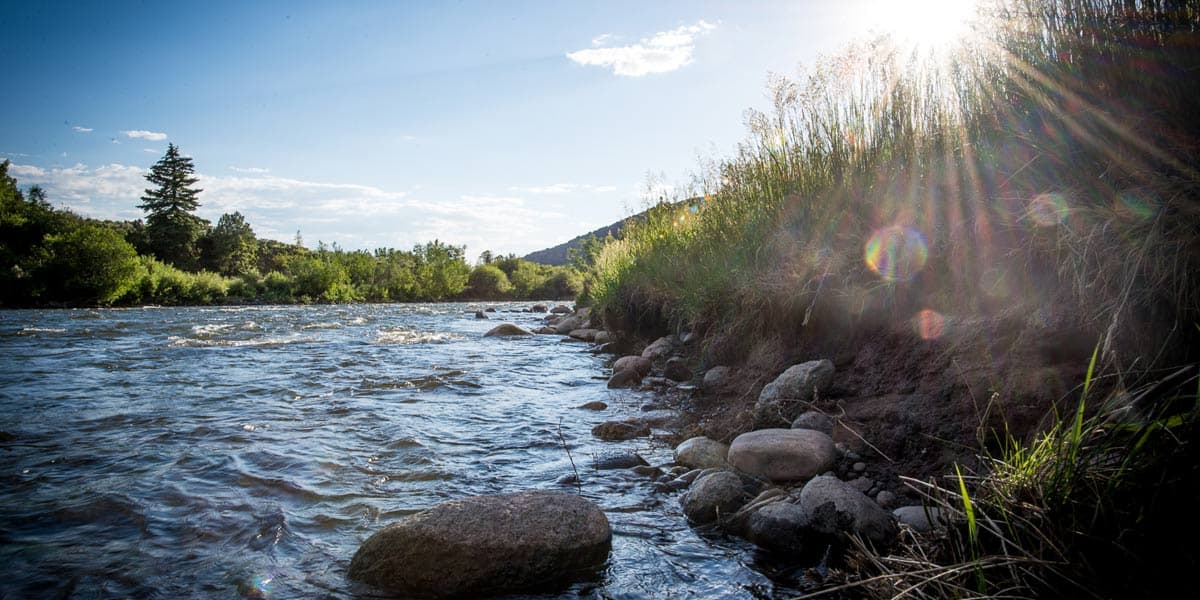



The Colorado River Compact is an extreme example of the adage “the numbers don’t add up.”
Consider: When seven western governors signed the Compact to divvy up the river’s water as an Act of Congress in August of 1921, the combined population of Upper Basin states (Wyoming, Colorado, Utah, New Mexico) and Lower Basin states (Arizona, Nevada, California) stood at 6.4 million. According to 2025 Census figures, combined population has now reached a whopping 64 million, an estimated 40 million of which depend on the river for water.
That’s hardly the only dramatic change. A recent Congressional report noted negotiators in 1922 assumed a flow of about 16.4 million acre-feet (MAF) per year at Lees Ferry in Arizona. Bureau of Reclamation records, however, show that from 1906-2024 the average flow was about 14.6 MAF, with that falling to 12.4 MAF since 2000 — a decline of 1.3 trillion gallons from the original assumption. So it’s no surprise that Lake Powell and Lake Mead, the massive reservoirs that store water and create hydroelectric power along the river, are at historic lows.
Here’s what hasn’t changed: each basin is still allocated 7.5 million acre-feet (MAF) of river water annually. (And Mexico also gets a share as a result of its later addition to the Compact.) All of which creates that additional problem I started with: How do you deliver to a population 10 times larger than when you started the promised amount of water when you have roughly 25% less of that resource?
There isn’t a statistician anywhere who can make those numbers add up. Which explains why Upper and Lower Basin states have been squabbling so much in recent years over how much water each deserves from the shrinking pie that the Bureau of Reclamation had to step in, announcing water cuts on Aug. 21 over the next two years for the Lower Basin states, the hardest hit by the river’s reduced flow.
There are no cuts contemplated for Upper Basin states, in part because they have never used their full allotment of water, thanks in part to a smaller combined population (13.8 million) than the Lower Basin (50.2 million). Another major contributor for Upper Basin states: They have been able to use mountain snowpack to fill their reservoirs, and so are not completely dependent on the Colorado River. However, that didn’t stop the state of Nevada from suing the federal government on Aug. 24, saying the ruling unfairly singles out the Lower Basin for cuts while not asking the same of the Upper Basin.
And snowpack, which I noted was strong in 2024, has turned fickle: The 2025-26 season in Colorado came in at about 50% of average, leaving state reservoirs at historically low levels. Blue Mesa, Colorado’s largest, was just 26% full on Aug. 20. Dillon Reservoir in Summit County was at 78% of capacity on July 20, according to Denver Water, and could be as low as 50% by spring of 2027. The Aspen Times reported on Aug. 21 that declining water levels at nearby Ruedi Reservoir forced the city to shut down the Ruedi Hydroelectric Facility, leading to a loss of power generation the city must replace through purchases from other sources.
Weather isn’t the only thing impacting water supply in the Upper Basin. The fast-growing needs of Colorado’s Front Range (Fort Collins, Boulder, Denver, Colorado Springs) has it competing with the rest of the state for water supply. Denver Water, which serves 1.5 million users, announced that Oct. 1 will be the cutoff for using sprinklers to water lawns, promising fines for those who do. Even more dire: the water agency called the sprinkling cutoff indefinite, even suggesting that watering in the summer of 2027 would depend on the snowpack. Additionally Colorado also faces interstate disputes with Wyoming over the North Platte River, Nebraska over the South Platte River, and Kansas over the Arkansas River.
The long-running drought has given rise to the notion of “demand management” strategies under which states or the federal government could pay ranchers and others not to use their water during certain periods. This past spring the Colorado Sun reported Colorado officials were working out the details for just such a program, which would be funded by $100 million from the Bureau of Reclamation, but it has not been finalized. On a smaller scale, I have written about the innovative rancher Paul Bruchez, whose creation of “riffles” (and other changes) in the section of Colorado River that runs through his property improved irrigation on his land.
There also are ideas from private industry to boost precipitation. Rain Enhancement Technologies claims it can increase the amount of rain and snow in an area by shooting “charged ions” into the sky from the ground, as opposed to the long-known process of sowing clouds with chemicals from a plane. The Colorado Sun noted the company’s claim that its technology added 8,750 acre-feet of additional snow last winter in Utah near Moab, but experts in climate science remain skeptical of its long-term value until there is more data.
All this talk of shrinking water supply amplifies the importance of understanding the water rights inherent to any investment in western land. As someone who has spent their entire career focused on water rights, I always tell buyers: If you can buy land with water, you should. This isn’t just about the stream flowing through your property; it’s about owning the water rights. Water rights have value and create value. Here’s my primer on the four kinds of water you might find on a ranch, as defined by the state of Colorado.
In the West, your rights are based on ‘prior appropriation,’ while in the East your rights are tied to adjacency to the water source, or ‘riparian’ rights. Surface water rights have value based on their seniority. The more senior the right, the better. Typically, a senior right gets its water allocation before junior users. Learn more about the history of Colorado water rights in my story about the case, Coffin v. Left Hand Ditch, which established western principles of water appropriation.
Should you be considering the purchase of a property that is being used to raise crops, it’s also important to evaluate what the water requirement is to produce each. In Colorado, for example, alfalfa and hay require more water to grow than sugar beets and peaches. When it comes to considering the purchase of a cattle ranch, here’s my guidance on how to grade its water resources.
And whatever you do, keep in mind the harsh weather reality of recent decades in the West. Having water rights does not always mean there will be enough water in the river, stream, reservoir, or ditch to meet your allocation.
Be the first to see the latest Ranch news and advice
 0
0
Start saving properties by clicking the + button on any property page.