
The shortgrass prairie might not seem as glamorous as our nation’s mountains and forests, but it’s one of the most important ecosystems in the West. This week, Nora Bales joins us to break down what shortgrass prairie actually is, why it’s suffered such debilitating losses, and most importantly – why we should care.
Want to watch this episode? Check it out on our YouTube Channel!
Links
Dryland Ecology Lab
Haley (00:06):
Welcome back to the Land Bulletin Podcast, where every other week we bring you experts in the field to impart their knowledge when it comes to the ranch and sporting property market, buying and selling advice, the latest best stewardship practices, as well as topics that impact landowners every day. I'm your host, Haley Mirr. Let's jump in.
Welcome back to the Land Bulletin Podcast. I'm Haley Mirr, and today we're going to be continuing in our grass voyage and learning about how important it is to our overall ecosystem and then ranching as a whole. And helping me out today as an ecologist at CSU, Nora Bales. Welcome to the show, Nora. I'm excited to hear about your research and what you found when it comes to short grass prairie.
Nora Bales (00:49):
Hello, Haley. Thank you so much. I'm really excited to be here.
Haley (00:54):
Awesome. Well, I would love to know first about your background and the research you've been doing as it relates to Short Grass Prairie.
Nora Bales (01:02):
Yeah. Well, I have always been a grassland kind of girl. I grew up in California in the Oak Savannah and the Sierra Nevada Foothills. And I don't come from a ranching family, but I come from a ranching community. And so the importance of grasslands has always just been part of my life. And as I went through my education and as I learned about ecology and botany, I began to realize that they're not just this natural resource that is always there. You have to take care of it in order for it to take care of you and provide the things that you need. And I had a really long and winding path to ending up at CSU, but first as a botanist and then as a short stint as a soil scientist. But really the thing that motivates me is I love these grasslands. I love the grasslands of the west and I want my life to be about taking care of them and making sure that the future generation can have them too.
(02:11):
So what I study at CSU is what I would describe as novel approaches. So new ideas in short grass prairie restoration, because this isn't a new field of study. People have been thinking about this for a really long time since the dust bowl in the 1920s. So I'm not the first person certainly. But as things have been changing, it's getting drier in the west. We're experiencing much more drought. We need some new ideas. And so that's what I work on.
Haley (02:44):
Amazing. Well, I love these kind of conversations because it gives me hope that we're all going to be okay because there's people like you that care about these things and have the mindset to fix it. For those listening who may not know, can you explain what Shortgrass Prairie is and where it's typically found? I know as a West as a whole, you'll see it a lot, but more specifically where you might find short grass prairie.
Nora Bales (03:10):
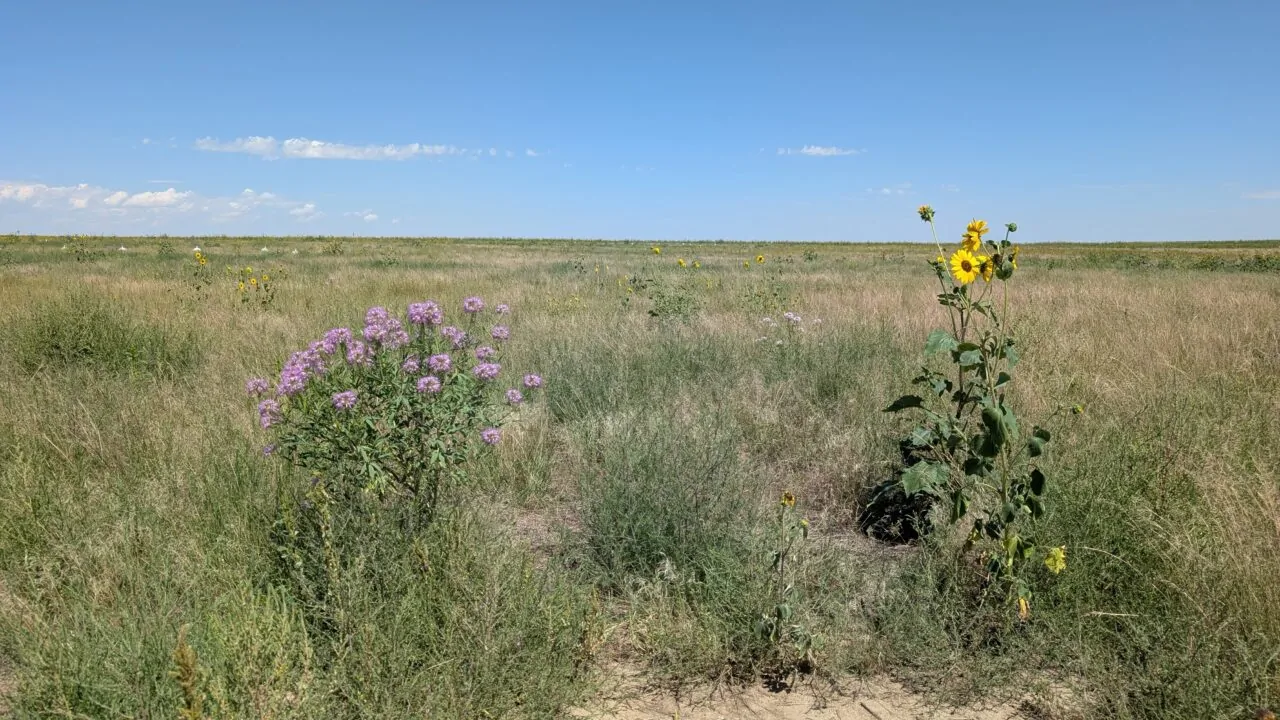
Totally. Okay. So Shortgrass Prairie is part of what we call the Great Plains, which is the largest grassland in North America. And the Great Plains covers more or less like the middle of the US up into Canada and a little bit down into Mexico. And you can find short grass prairie on the western edge of that. And this goes all the way from Saskatchewan and Alberta and Canada through Montana, Wyoming, Colorado, New Mexico, and into the Texas Panhandle. This is the driest of the Great Plains grasslands. And it's called Shortgrass Prairie because the grasses there are short. And this is particularly in contrast to the tall grass prairie where the grasses are tall. And that's a reflection of the climate. It's dry, so everything is smaller out here.
Haley (03:58):
And when people see those expanses of short grass prairie, I know a lot of times when you think of national forest and things that bring you awe, you always think like, oh, that's what we need to protect. But what makes these ecosystems so important and why is shortgrass prairie so important to uphold when it comes to the overall kind of habitat?
Nora Bales (04:19):
Totally. Yeah. So I think, like you said, it's not like this sweeping mountain forest or something like that. And so there isn't necessarily the same sense of grandeur, but when I see shortgrass prairie, I find so much beauty in the subtlety. And I think if you just go to the short grass prairie one time, you might not be able to capture this feeling. But I've been so lucky to work on this landscape across seasons throughout different days on the hottest days, the wettest days, when it's been snowing, when the winds are absolutely blowing, or when it's just the most beautiful spring day. And watching this landscape, which at first glance is kind of gray and sort of subtle, completely green up and watching it come alive in the spring is one of my most treasured experiences. And so it's important to us for many reasons.
(05:13):
Culturally in the West, Shortgrass Prairie is one of our economic hubs. We graze livestock on these lands and a lot of people throughout the west rely on shortgrass prairie for their entire livelihoods. And it's core to their cultural identity. So that's one reason why it's very important. But if you kind of take a broader look and think about the ecology, shortgrass prairie provides a lot of what we call ecosystem services. And so these are just things that land provides to us just by nature of existing. So for instance, like forage production in shortgrass prairie is an ecosystem service because these grasses were already there. We didn't put them there and they are self-sustaining all things being equal. And other things that it provides are things like carbon sequestration, which is so important as part of our climate. It helps regulate the temperature on the surface of the earth.
(06:09):
And it supports amazing biodiversity. Shortgrass prairie is home to species that aren't found anywhere else in the world. Think of pronghorn, buffalo are from the Great Plains and also range through the Shortgrass Prairie. So it's special for so many reasons, but those are a few.
Haley (06:29):
Oh, I love that. Well, that's not just a few. That's a lot of very important things that kind of bring everything together. And I know there's a lot of groups out there that are helping with conservation and things like that. But before we get into some of the mechanisms to try and protect these places, can you tell me a little bit about why this has become an issue in recent years? To give people a visual, maybe how much short grass prairie did we used to have and where are we at today?
Nora Bales (06:58):
Yeah. So we didn't necessarily have satellite imaging and like all these high tech geospatial technologies like several hundred years ago when America was starting as a country and people were moving across the west. But our estimate is that short grass prairie covers and the historic range of this ecosystem is about 150 million acres, which is huge. Wow. That is so much land. And over the last 150 more or less years, we have lost about 50% of that. And that is quite a bit. Within Colorado, which is where I work, that statistic is still true. We've lost about 50% of the extent of shortgrass prairie. And
(07:48):
Crazy enough, that is the largest loss of any single ecosystem type within Colorado. So even compared to forests and wildfire and stuff like that, our loss of shortgrass prairie is one of the greatest losses of any ecosystem within the state of Colorado. A lot of things that make this kind of a tricky problem. One is that short grass prairie is mostly held in private hands, which can be a good thing. There's a lot of ranch owners out there that do incredible work conserving their land, but also that no formal protections for this landscape exist, unfortunately.
Haley (08:22):
Right. And that's kind of where we got back to national forest and these federal mechanisms that protect these spaces sometimes that doesn't really … If you look out into the eastern plains, it's like a big checkerboard of state lands and things like this, but it's not these big swaths that you kind of used to when you see protected areas. So I guess without straying too much from like the questions that we have right there for you, what role do ranchers play in some of this when it comes to … Because you said the majority of the shortgrass prairie does exist on private land.
Nora Bales (09:03):
I would say that ranchers are perhaps the most important people when thinking about shortgrass prairie conservation because these are the folks that have the land and they're the people that rely on it to provide forage and a home for their livestock. So I would say that ranchers are absolutely central to this, to this question of how to restore shortgrass prairie, how to conserve short grass prairie. And that does make things a little complicated. Like you said, there's this huge checkerboard of whose land is whose, what jurisdiction it is. And if you're working with like multiple different people who have different ideas about how they want to manage their land or what their goals are for what their land looks like, then I think that is one of the barriers perhaps, but it's also one of the solutions…so it’s complicated.
Haley (09:57):
It's a complicated … I feel like it always is. There's always so many systems and things like that. So I completely understand that. So when we were researching some of the work that you're doing, we saw this term come up about trait-based restoration. What does that mean? And a lot of our listeners are ranchers. How does that incorporate maybe into some of their management techniques or what they can be looking into?
Nora Bales (10:24):
Yeah, great question. And I'm going to try not to get too academic on you, especially because I know you have a really diverse audience, but there's this kind of newer field of ecology that studies something called functional traits. And I think the best way to describe a functional trait is kind of to think of it as a personality. So it's this characteristic of a plant. In my case, I study plants that kind of defines what it does in a system. So I'm stepping back from thinking about species identity. I'm not like, okay, I'm thinking about blue gramma only, blue gramma just as an individual. I'm thinking about its personality. What does it do? Well, blue gramma is a shortened stature grass. It does really well with grazing and it is super drought tolerant. So these are the things that functional traits can sort of capture.
(11:25):
And this is kind of a newer field of ecology, but it's not a newer idea. People working on the land and ranchers, practitioners have been thinking about this concept for a very long time. To describe what a plant does versus who it is, is something that I didn't invent and that scientists didn't invent. But because I work at a university, because I'm in research, we have to put numbers on things and do statistics and test our ideas and stuff. So the formal definition of what a functional trait is, is it's a morphological, so a way that a plant looks, a phenological part of its life cycle or physiological part of how it moves nutrients and water, so a morphological, phenological, or physiological characteristic that determines how a plant interacts with its environment and with other organisms. And so there are specific functional traits that we're really curious about because they're super informative about different plant personalities that are important for short grass prairie restoration.
(12:29):
So short grass prairie, as I said earlier, is the driest of the Great Plains grasslands, and it gets very low annual precipitation, like 12 to 15 inches, maybe a little more, depending on where you are. In Colorado, we're looking … Eastern Colorado, we're looking right around that like 12 to 13 inch range. So to restore this landscape, we need to really think about which plants are super drought tolerant. And some of this we know anecdotally, but to apply functional traits to restoration, we're thinking about things like rooting depth or like the thickness of leaves that are … And you can measure that like empirically, which tells you how resistant they are to desiccation, which tells you that they'll survive through these super dry periods. So yeah, that's how I've been applying functional traits to restoration. It gets a little more complicated than that, but …
Haley (13:24):
And I don't know much about some of the ecological pieces, but I do know in these areas, because they become drought resistant and we really do not get that much rain in the eastern plains, what are some of the other ways that short grass prairie is receiving its nutrients if it's not getting necessarily from rainfall?
Nora Bales (13:48):
Plants need a couple different nutrients that are totally essential to them to survive. And a lot of that actually comes from the turnover of plant material. So plants die, they drop some of their leaves and it reunters the soil and is cycled back through. Another really important mechanism for nutrients in the system is through animals doing their business on the landscape. That's a really important input. But something to bear in mind is that shortgrass prairie is dry and it's actually not what we would call a high productivity system. And that isn't like a judgmental term. I feel like that sounds like bad if something's low productivity, if your boss is like, “Well, you have low productivity,” that's a bad thing. But what I'm trying to say is that the grasses don't get very big and they grow very slowly and they produce some biomass, but not tons and tons and tons.
(14:52):
And that's because of the inherent limitations of this system. So nutrients are moving through it, not a ton of them, but one of the most important mechanisms for nutrient turnover in short grass prairie is actually through roots of plants. And so we talk about plants in kind of two broad categories as perennial and annual. And so annual species are ones that grow, reproduce and die in one growing season and perennial are ones that live for year after year after year. And perennial grasses are so important in short grass priority because they have these huge root systems that are like incredibly large, so much larger than their above ground biomass, like several feet deep into the soil. And through those roots, plants are turning over nutrients, storing carbon and associating with soil microorganisms to keep the soil healthy and keep it from eroding in these systems.
(15:51):
So everything is connected.
Haley (15:53):
Wow, that's amazing. And we looked … I mean, it's just crazy because you look it out there and you don't think any of this is happening. So the fact that there's like this other system underneath the ground and that people just aren't aware of is pretty cool. What are some of the other obstacles or barriers that you are facing in your research when it comes to short grass prairie?
Nora Bales (16:18):
Oh, man. I mean, it's tough out there. I'll start with that.
Haley (16:26):
Okay.
Nora Bales (16:27):
The things that make short grass prairie that define it are some of the things that are huge barriers to restoration and why this research into new ways to do restoration is needed. It's dry. And we all know that plants need water to grow. So we can extrapolate from there that if we have a dry year and we're trying to do restoration, we're putting plants on the landscape, they're probably not going to make it. And so to see your restoration project not work or to see your research not succeed on the first pass can be really hard and very disheartening. But something that I try to remember is that shortgrass prairie, this plant community formed over hundreds, over thousands of years actually. And we've done damage to it over a hundred years. And so it's actually going to take a really long time to restore it.
(17:24):
And so I have to remind myself to be patient all the time. Patience is so difficult, but yeah, trying again after failure, and I use failure kind of as loosely there. We're getting germination, just not as much as we would like. And then another barrier that's really difficult is the presence of invasive plant species like cheek grass and Russian thistle. They're so tough. They're so competitive. They have completely different life cycles than native shortgrass prairie species and coming up with ways to grow resilient plant communities that can either like out compete or kind of balance and live in some novel new assembly of species with some invasive species is really, really tough.
Haley (18:17):
I can't imagine. So I mean, what are the things that through your research you have found and are some of these tools things that ranchers can start using or larger statewide organizations can start using? What are you finding that's helping with … I know it takes a while for these things to happen as it happened. It took a hundred years for us to destroy it, but what are some of the things that you have found that you have found useful when trying to reintroduce some of the species back into the environment?
Nora Bales (18:48):
One approach that I've been taking that actually has shown a lot of promise and I'm very excited about is this idea, so we're looking at short grass prairie. We see that it's degraded. We see there's tons of invasive plants on the landscape, and that is really disheartening. But I'm going to be optimistic looking at this because I see plants growing on the landscape. It's just not the plants that we want to grow there. And so using like a functional trait approach, can we describe the personalities, the strategies of these invasive plants and use that information to pick native species that have similar strategies that can … Because these invasive species are growing year after year, they're surviving, in some cases thriving, that means that they have something about them that makes them able to persist in short grass prairie. And when we talk about restoration, it's kind of complicated because I'm not talking about going backwards, right?
(19:47):
Too much has changed. The world that we live in now is totally different than the world of short grass prairie before we introduce cows, before we introduce agriculture. So there's really no going back to that point, but there is going forward. And there is some level of restoration that we can do that reintroduces function back to shortgrass prairie, where we are getting deep rooted perennial species that are turning over carbon, where we are getting better soil stabilization and better forage for our livestock. And in this method that I've been trying out and seeing some good results with, I think one thing that I would really love to do is use all of my data that I've collected on the invasive plants that grow in short grass prairie and then the native species that we've been using for restoration and make a tool where someone can be like, “Okay, I live in this part, I live in Eastern Montana.
(20:46):
The annual rainfall is this much, the soil type is this, and here are the major invasive plants that I see. What are some good species that I can plant?” And it would be as simple as that. So that is my end goal to make it useful for people, but the process of figuring out this information has also been really fun. Well,
Haley (21:05):
I think it's, to your point, it's like, okay, a hundred years ago, the world looked a lot different. There are a lot of different types of species that have since become a part of our ecosystem. And how do you integrate what we're trying to create while also being aware that, okay, this is what it's like now. These things grow. How do we kind of create this new type of ecosystem that works for all the systems that we do need from water, what is it, like cleaning the water to helping our livestock. There's all these different kind of variables. So it's nice to have a positive outlook on where this is headed and that it might just be a little different than what it was a hundred years ago.
Nora Bales (21:53):
Yeah. And you can be sad about that. That's okay. I'm sad for the things that I lost and the way that things have changed. I wish I could have stood in Weld County, Colorado where I work and seeing bison, that would have been so cool, but the world is different now and that's okay. And I feel really hopeful that there's so many smart people working on this and there's a lot of motivation to tackle this problem because it's so important to people in the West to have resilient working landscapes in short grass prairie. And so I feel really hopeful that the research that we're doing and the restoration work that we're doing can work towards something good and that we'll be able to achieve some positive change and do good work on Shortgrass Prairie.
Haley (22:47):
I love that. This isn't one of the questions and maybe it's not happening, so if it's not, feel free to not respond. Is funding for your research or are there other projects that are doing similar things being funded by statewide or federal organizations or is it privately funded or is it coming from universities or who's kind of spearheading some of this work?
Nora Bales (23:18):
Yeah. Well, there's actually some incredible federal agencies and state agencies working on this along with some nonprofits and some private folks. So the USDA Agricultural Research Service has been working on short restoration for a very long time. I mean, the roots of this problem are in the dust bowl, which happened in the 1920s. And the USDA developed programs starting then to start thinking about this problem. So there's been funding for this from where I stand, there's never enough. I would love to see a lot more. I know that Colorado Parks and Wildlife is working on this issue. The Nature Conservancy is working on this issue. The National Forest Foundation is working on this issue. So there is a lot of motivation.
(24:11):
I think that it is going to take more funding. I think it's going to take more people. I think it's kind of an expensive problem, unfortunately, because we don't have the solution just yet. And there's no one size fits all approach for everybody's piece of land for every part of Shortgrass Prairie. So there are still a lot of questions that we don't have the answers to. So there's, I would say, a definite need for more research funding, but also a huge need for practical funding. We need people out there doing the work. I'm testing my ideas on a very small scale, but we need to do this kind of work on the scale of thousands of acres, not just tens of acres, which is where I'm working.
Haley (24:58):
Well, that kind of brings up one of my other questions is, how does your research apply to real world practices at scale? So some of the ranchers that are listening, they probably are experiencing this more than anyone firsthand. How could some of the things that you have found, and maybe it's still ongoing and you don't know how this can apply and that's the point of what you're doing, but what is your hope then of how this research will apply to these real world at scale practices?
Nora Bales (25:31):
Yeah. So ranchers are doing at scale work to seed short grass prairie species through kosher programs like CRP, for instance. And so seed-based restoration is a thing that's already happening. It's been happening, but the problem that we're seeing is that our outcomes are not what we want. We're just not seeing the establishment, we're not seeing the recruitment of our seeded species. And so what I'm hoping this research can do, the work that I'm doing, is it can feed into programs like that and help inform more site specific mixes to change how we're seeding a large scale for restoration.
Haley (26:17):
Okay, got it. And have you seen that succeed in some places or …
Nora Bales (26:23):
Yeah. There are some projects happening in Eastern Colorado that I've been fortunate to get the chance to observe and they are doing large scale seeding and they have been seeing some cool outcomes. So there is hope. My message today is that not all is lost. We got this. We just need to work really hard on it.
Haley (26:49):
And how, because I know a lot of the shortcut peri is in our neighbors that we care about and there's a ton of horrible fires happening in Nebraska right now. How imperative as these droughts continue and the climate continues to change and we're seeing just kind of these elongated periods of no water, how imperative is it to continue to fund this restoration work and where do you see the future of some of this restoration work headed?
Nora Bales (27:22):
I would say, because my livelihood relies on it, also that it is absolutely essential to continue to fund this restoration work. There's not just my job at steak here. There are people's ways of life, like people's entire livelihoods and their history and their culture. The whole reason why some people live in the West hinges on healthy shoregrass prairie. And I worked with a rancher once and he did this really cool regenerative grazing practice, which is not totally related, but he said something to me that really sticks with me, which is we take care of the land and the land takes care of us. And so it's the cycle and it's tough in a warmer, drier future to think of how this looks or are we going to be okay? But one thing to keep in mind, and particularly with fires, shortgrass prairie evolved with fire and it is resilient to fire versus invaded system that has a lot of cheekgrass in it that totally changes the fire cycle and shortgrass prairie can recover if you have these perennial species, they can recover from fire.
(28:34):
So the future that I see for research in shortgrass prairie and shortgrass prairie restoration is thinking about ways to build and restore just resilient, sustainable landscapes to preserve these key ecosystem services that we rely on and also these ways of life. I grew up in a ranching community and I have so much love for being outside and this way of life in the American West, it's so special and I think that this work will help keep that alive for future generations.
Haley (29:15):
I'm just, like I said at the beginning of this call, it's really nice to know that people like you exist out there. What are some of the other organizations that you've seen in the nonprofit? I know we talked about some of the funding and everything, but who are some of the key researchers and teams and things that are doing incredible work that maybe you've worked with in the past or you see them kind of figuring out some interesting things that we could be using in the future?
Nora Bales (29:44):
Yeah. Well, there are some really cool people at CSU that I work with. There's two researchers, Mindy Smith and Alan Knapp. They're a team. They've just been working on this problem for so long Long. And they do really incredible work, especially looking at ways to integrate new ways of using land in the future. They study a lot of ecovoltaic stuff. The Central Plains Experimental Range, SIEPR, is the abbreviation, is a research station in Nun, Colorado and UNN. And they've been working really hard on this too, thinking about how drought affects the resiliency of Shortgress Prairie. So that's a great place. They also cross a lot of their research with grazing, which is so important because these are working land. So any of the work that we do has to include that. Let's see. There's projects happening on the Pawnee National Grassland, which is a really beautiful piece of federal land in Colorado.
(31:01):
There's just really excellent people working for the USDA Agricultural Research Service here in Fort Collins. I would really recommend looking at the work of Lauren Parensky. She's a brilliant scientist and does a lot of great work. Those are the ones I can think of off the top of my head, but there are so many people. There's so many.
Haley (31:28):
Well, I think it's impacting a ton of communities and it has a vital importance to people in different ways throughout the West. So it's important work. It's neat that there's a lot of just exchanging of ideas happening and a lot of smart people. And I heard there's a lot of cool women out there doing a lot of cool work, which we love.
Nora Bales (31:52):
There are, yes.
Haley (31:54):
Love to hear that. But I'm excited just to continue to follow what you're finding and providing that to our listeners, our clients, our friends, to know how they can support this important research and then how to implement it into their own management practices. I think that's a big … How we can help, at least, with what you're doing out there.
Nora Bales (32:20):
Yeah. Yeah. Yeah. And I think one thing that academia and research sometimes does wrong is we lose sight of who needs this. Because we spend so much time inside, we spend so much time on our computers that sometimes you forget why this is important. And I try to stay grounded in that and try to stay humble too, because I'm really lucky to work with this excellent family in Eastern Colorado. They've graciously allowed me to do research on their ranch, and I'm so grateful for that. And the amount of knowledge shared between these two people from their time living on this landscape is just vastly more than I could ever collect through data collection, through experiments and whatever. And yeah, the more chances that we can talk to each other, the more chances we can share our knowledge and share our information. Because ultimately, I'm pretty sure that we all just want the same thing, which is to see Shortgross Prairie persist into the future and see ranching in the American West persist into the future.
Haley (33:33):
I would agree. Well, I am so grateful, like I said, to have you on the show. I'm excited to see where your research takes you next. And however we can help spread the word or send out some of the things that you're writing in your studies, we're happy to do so. So thanks for taking time out of your busy day to join us today. I appreciate it.
Nora Bales (33:57):
Haley, it was my pleasure. Thank you so much for inviting me on. This was a joy to talk about with you, and I'm just so grateful.
Haley (34:05):
Awesome. Yeah. We'll just keep bringing you guys information on grasses because it's the most important thing we got out there. So thanks for coming in. Nice to meet you too. Bye.
Thanks for joining us today. To learn more about the Ranch Real Estate Market or our ranch marketing process, make sure to subscribe to our newsletter on our website at Mirranchgroup.com or give us a call at 303-623-4545. See you next time.