
This week, we’re headed down to Texas to chat with Max Kruemcke, co-owner of Bastrop Cattle Company, about what it takes to build a successful small-scale beef business. After an unexpected shift from the film industry to life on a cattle ranch, Max shares how he used his background in production and marketing to help Bastrop Cattle Co. evolve from supplying restaurants to shipping beef directly to customers across the Lone Star State.
Want to watch this episode? Check it out on our YouTube Channel!
Links
Bastrop Cattle Co.
Haley (00:06):
Welcome back to the Land Bulletin Podcast, where every other week we bring you experts in the field to impart their knowledge when it comes to the ranch and sporting property market, buying and selling advice, the latest best stewardship practices, as well as topics that impact landowners every day. I'm your host, Haley Mirr. Let's jump in.
Welcome back to the Land Bulletin Podcast. It's Haley Mirr here. And today we're going to be traveling south down to Texas to meet with Mass Kruemcke. Max Kruemcke is a friend of the podcast, but also the co-owner of Bastrop Cattle Co. We're going to be talking about what goes into marketing and distribution of a small beef business, how Max got involved in all of this. I love his background. And then tips and tricks for ranchers who are looking to start a small business similar to Bastrop Cattle Co. So without further ado, thanks for being on the show, Max.
Max Kruemcke (00:57):
Thank you so much for having me.
Haley (00:59):
So where are you hailing from today? Are you on the ranch or where are you at?
Max Kruemcke (01:05):
I'm on the ranch right now. Yeah, we're just outside of the Bastrop City limits, which is about 40 minutes east of Austin.
Haley (01:15):
Okay, great. And what got you here today? Were you always on a ranch? How do you find yourself here today? What's the background?
Max Kruemcke (01:25):
Definitely not. So my partner had been working with the ranch owner, Patty Jacobs, for I want to say over a decade. And I was working in film in Austin. I was born and raised there, went to film school and was like, “Oh my gosh, I'm going to move to LA and do all of that. ” Didn't move to LA, ended up meeting my partner instead. And then after a number of years working at a YouTube company in Austin named Rooster Teeth, and I was doing art department on film sets and stuff. Eventually kind of wanted to change a pace. And then we had already moved out here a few years prior to this, but in about 2019, I was like, “Okay, I'm going to take a break from doing the film thing. And then for right now, I'll just help out a little bit with Bastrop Cattle Company,” because Patty and Brandon had already been running that for a number of years prior to that.
(02:23):
And so yeah, I decided to, as my first order of business, tune up the website, make it look nice, use some of those graphic design skills. And that was in super late 2019. So by 2020, when everything went down, it was like, oh, well now- At least you're here.
(02:42):
Yeah. And then basically, yeah, it was like six years after that it was like, oh, actually no, I think this is what I love the most and it's the most fun.
Haley (02:51):
That's amazing. And so I know you guys came in a little bit later, but when Patty was only running it, was it direct to consumer or when did that start? Because I know that's kind of your big business model.
Max Kruemcke (03:03):
Yeah. So basically Brandon and Patty, whenever they were running it for, I think it's because I think the company's been around for, I want to say around 16 years or so now or something
(03:14):
Like that. But basically it was mostly wholesaling to farm to table Austin restaurants. And so especially back in the day when that was a huge priority for a lot of chefs, Patty started out at the farmer's markets, then she built relationships with the local chefs around and then they would be supplying them. But also she would still do the custom cut half and whole cows. And then she would also do a little bit of in- person retail, but not … It was more like one person would come over to the ranch, she'd talk to them for like 30 minutes or so, and then they'd buy $25 worth of beef. But yeah, whenever I started, I was just basically looking at all the other ranch websites, like finding out how other people sold it. And it was funny because I was like, some of them can be very, very complicated and confusing.
(04:12):
There's a shocking amount of math that for some reason whenever you're trying to buy from a farm or a ranch, it's like, okay, you're going to get 7.5 ounces, but it might be eight ounces, but then the next dropdown thing is eight ounces to 8.5 ounces, just completely crazy. And so yeah, we basically were like- Made it a little simpler. What if we made it? Let's make it easy for customers to give you money.
Haley (04:39):
That's amazing. Yeah. It's so funny you say that because I had friends over for dinner last night and they were talking about just kind of how difficult it's been for them to navigate because they really want fresh farm to table stuff for their kids and things like that. And they said meat in particular has been very difficult to navigate. So it's nice that you're making that a little bit more accessible to the common user, I'll say. Well, I
Max Kruemcke (05:04):
Think it's funny because I never knew … I had grown up, my extended family is from more like Giddings area, which is a little bit further east from Austin. And basically the traditional method, which a lot of people are super familiar with with a half or a whole cow is basically like you pay the live weight, then you pay the processing fee, you talk with the butcher, you figure out all the cuts yourself, then you pay a kill fee and then maybe a packaging fee. And it's like, again, the amount of math is completely overwhelming. I was just like, I would've never thought.
Haley (05:44):
I feel like it dissuades people from wanting to even get into it because they're like, “Okay, I'll just get single use cuts every time I go to the grocery. Why do I need to go through this? ” So okay, I like where this is headed. And before you even got into marketing, where did you see the need for this? How did you decide that this was the strategy that you guys wanted to kind of go towards?
Max Kruemcke (06:07):
So I think it really was completely kind of, I always say it was like the transformation from a mostly wholesale business to a direct to customer business was kind of a decision that was made for us because whenever I started in December of 2019, I was like over there. We were still going to chefs and giving them samples and then being like, “Let's get all of this. ” And then yeah, basically whenever COVID happened and all of those places had to shut down, then also the big processors also shut down, but because we were processing at a small Texas state inspected butcher, we were still able to process. And so weirdly enough, by figuring out at first we were actually delivering everything in person, which was completely crazy. I had basically left my job to become a full-time delivery driver essentially. And then it was funny because my partner kept on saying like, “Oh, eventually we're going to ship everything.” And I was like, “You can't put beef in the mail.
(07:15):
That's completely crazy.” It definitely turns out you can. And so through process of basically figuring out how to make that process, through the process of figuring out how we basically put it in a box, put it in the mail, it arrives the following day to the customer's house, it just made for a lot more of an easy experience for everybody. And I think rather than us having to worry about competing with a farmer's market or having to do really high lift in- person stuff, just basically making it easy enough for one customer and then those customers, like 90% of our marketing is word of mouth a lot of these days. So yeah. I
Haley (08:02):
Was going to ask because I feel like that's the biggest even with our business is how do you reach the right clientele? What are all the different marketing avenues that you take in order to access those people? So it's a lot of word of mouth, referrals.
Max Kruemcke (08:16):
Yeah, I'd say that it's like because the primary focus for a lot of the way that we do it is purely customer retention, getting customers in. And the other big thing is even though we're not at a farmer's market table, it's like we make ourselves very available, or rather I should say I'm the customer service department. So when somebody's texting the company, they might not get a response immediately, but they are going to get a very direct, genuine, real response from us. And then anytime there's any sort of issue or something gets delayed, something doesn't show up in the mail, always being super flexible and being like, “Well, yep, I'm not going to be like, sorry, UPS accidentally left it in a warehouse somewhere, but your problem now, no, we don't do any of that. ” And so basically through customer retention as our primary focus, that's been the main way that we kind of keep everything going.
(09:18):
Outside of the rest of that, I would say that the next thing is basically emails. I remember there was a chef in Austin whenever we were trying to figure out how to promote more of our stuff, and it was funny because she said, “Oh, no, just send an email newsletter.” And for me, I'm like someone who almost pathologically doesn't read emails and doesn't check them. So I'm like, “Well, who would want a company email?” Turns out a lot of people do appreciate it. And we also kind of use that one to make it a little bit more fun. We put a little bit of ranch stories of whatever's going on, even if it's the most boring story, like we've got a mulch pile and there's something fun about it.
Haley (10:04):
I love that. I checked out your website. It is fun. You go to a lot of these cattle companies and it takes away the artistry and kind of the fun of it. And I think you guys have done a great job of soliciting that still.
Max Kruemcke (10:19):
Oh, thank you. Yeah, no, it was really funny because over the years, the first time, because Patty, the ranch owner, she's always been actually pretty tech forward for someone who's a little bit older, but she had an old website that was pretty reasonably decent, but it was funny because when it came to product photos, I think that some of the cuts she would leave … I joked that some of the cuts she would leave in the packaging and it was like a digipixel that had the flash on. And so it kind of looked like somebody went into a spooky haunted house with some ghost beef around there. It was really, really random looking. And the other funny thing about trying to figure out how to do product photography or getting product shots, because I know I could use stock images, but I don't know, something about being the proud ranchers that we are, it's like, “No, no, no, I want to have our product because we're grass fed, grass finished.” And so it doesn't look like you can tell whatever it's like, “That's not grass fed.” That's
Haley (11:34):
Not.
Max Kruemcke (11:36):
But yeah, and it was funny trying to figure out situations, it's like there's only a couple of situations where you want to see photos of raw beef. Yes,
Haley (11:46):
It's not all the time.
Max Kruemcke (11:48):
Yeah. I was like, it has to be on a piece of parchment paper on maybe a wood or a neutral background, but something's got to be under it. It's got to have that butcher shop feel, otherwise it's just like, that's just a random chunk of meat sitting around somewhere.
Haley (12:05):
Yeah, that's not appetizing.
Max Kruemcke (12:07):
Yeah.
Haley (12:09):
So I'd love to know just your process even. So how big is the ranch that you guys have cows on?
Max Kruemcke (12:17):
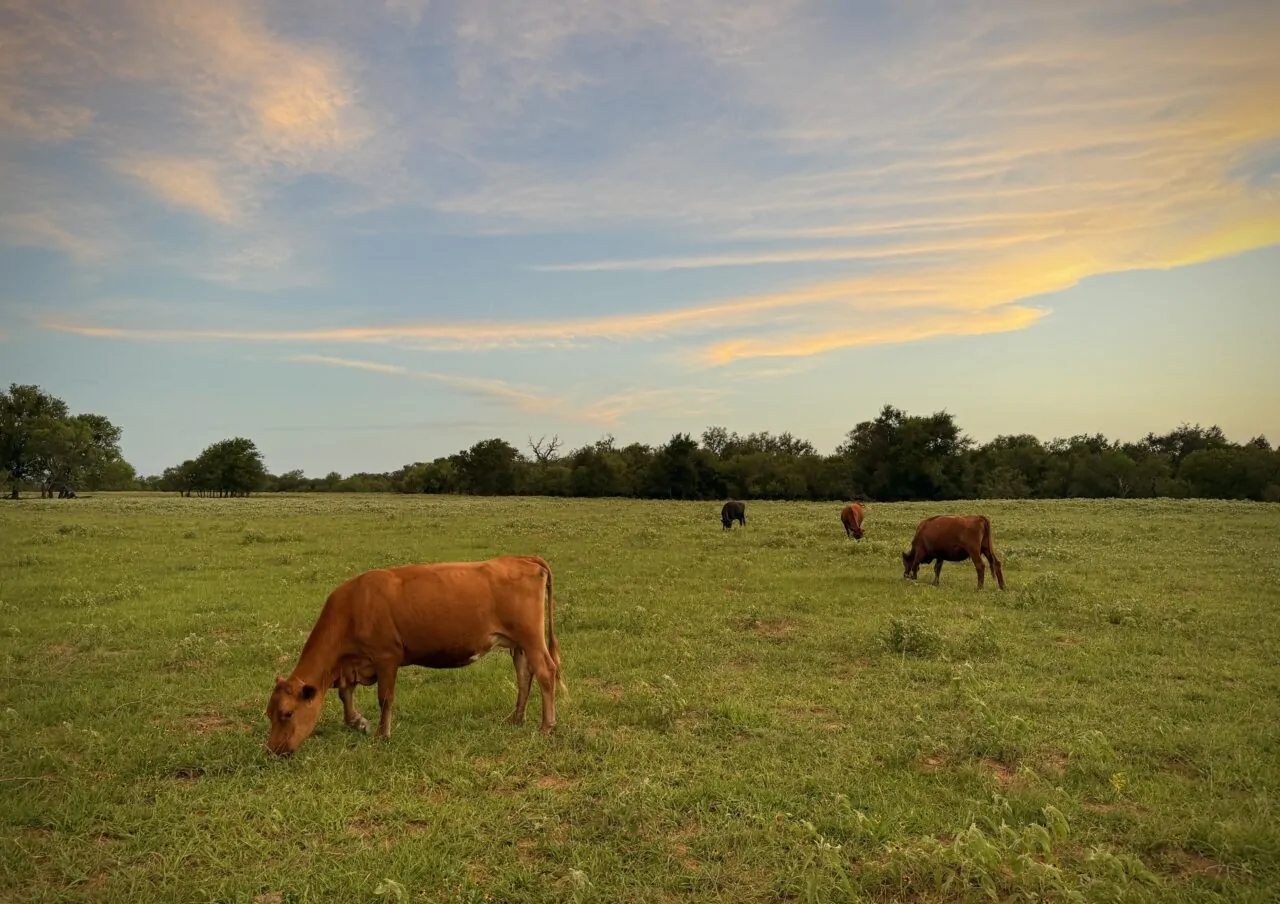
Yeah, so basically the actual ranch, the CJ Ranch, which is Patty's ranch that we're on right now, that one's about 230 acres, and we also lease another a hundred acres next door, but the cattle company is basically a co-op of three different family-owned ranches with one other one in Bastrop, and then the other one is kind of more near La Grange, about an hour away. And the way that we've kind of done that is we've been spreading our genetics evenly throughout the herds over the years so that they're very consistent. And then also basically with our ranchers, it's like we've been working with them for years. They basically sell only to us and then yeah, we sell it to the public because they aren't interested in doing the customer service part.
Haley (13:11):
Oh, amazing. Okay. So it's kind of like we actually had some good friends up in Montana, the Old Salt Co-op. They help a lot of these ranchers, which feels like you guys are doing the same, navigate this way of bringing meat to the public and to the market versus just sending them to the middleman and going from
Max Kruemcke (13:31):
There. Yeah.
Haley (13:32):
Okay.
Max Kruemcke (13:32):
Exactly. Yeah. Because at least around Texas, I'm sure it's happening pretty much everywhere, but it's like there's not as many auctions as there used to be and the auction prices change. And so yeah, for a lot of the ranchers, the families that we've worked with over the years, it's like they're very much like, “Yep, let's make it easy. Let's get this done. We'll be consistent.” And then they have to be raising it in the same practice. And thankfully, because they're right nearby, it's like we're always able to go and check things out and make sure everything's going well, because that was started before I joined and basically that was the big thing was that BCC was always kind of the interesting place for chefs to work with because chefs would work with smaller ranches that would have their amount that they could produce a few times every quarter.
(14:32):
Whereas with ours, we were consistent. We could be consistent every week because all of them are raised in the same way at the same time, and they're all basically processed in the same way. So yeah.
Haley (14:46):
So you were able to monitor and make sure everything is being done the same across the board. Are there any regulations that as ranchers are listening to you and what you guys created, any regulations that people need to be mindful of when doing a practice like this?
Max Kruemcke (15:05):
So I'm not entirely certain, I'm not the policy or rule, the one who's super experienced with all of that. I know that
(15:15):
Brandon, way more of that, but I will say that for us, I know that for our label claims, we've got the all natural, which basically means no hormones, no antibiotics. And then in terms of grass fed and grass finished, on the label, we always have to use grass fed all natural because those are regulated terms. But yeah, whenever we're talking with customers, we're always telling them about we're grass finished because yeah, we don't do any of that. It's funny because when it comes to other certain terms, there's certain terms that we've just never been interested in paying for the organic one. We're like-
Haley (15:58):
Yeah, we're good. I mean, there's so much that people, I don't think that could be an entirely other podcast about
(16:06):
The different types and how to certify yourself as X, Y, and Z. But it's good to know just too, while we do sell some really big ranches, there are a lot of people who have purchased these, I don't want to call them hobby farms, but like smaller properties where they want to find ways of generating income, but they don't know where to start. So what you guys have created, I think is a really cool business model. How much of your business model is devoted to storytelling, talking about the ranchers, talking about the people that work these landscapes?
Max Kruemcke (16:38):
Yeah, it was funny because I think unlike a lot of brands lately, we haven't really been focusing as much on the storytelling. What we've been focusing a lot more on lately, because it is completely ridiculous and wild, customers these days are really, really well versed in issues that face the beef industry. And so they will take any bit of knowledge, anything that you have to offer. It's completely wild. Whenever I started, that was not the case. I would occasionally hear people talking about claims of things that they heard were going on and some of them would be like, “Yep, that's a real practice from the larger processors.” And then some of them would be like, “Nope, that's just crazy town.” But now it's funny because with YouTube and with podcast, and I think also the fact that the grocery store beef keeps on going up in price, a lot of customers are getting way more curious about where their actual food comes from.
(17:44):
And that's been primarily the benefit for us is that being able to tell them, talking about every single butchery cut or whenever they're like, “I don't see this cut. Why don't y'all cut this one?” And then I have to be like, “Well, we process our animals a little bit younger, so our tri-tips are a little bit too small, so we recommend a different cut instead.” But yeah, we basically do a lot and are trying to continue to do even more just as much information as people want because it doesn't seem like there's a limit. It's kind of wild to me.
Haley (18:21):
Yeah. I feel like, like I said, this podcast is fun because we learn about all these business models and all these things, but there's so much that we could just continue to divulge in and figure out more about. So it's good to know though that I would love to hit on what you said. What was the choice to slaughter some of the cows a little bit younger? What was that strategy?
Max Kruemcke (18:46):
Yeah. So basically Patty Jacobs, who started the company, she was amongst, I think, one of the first who was really doing grass-fed whenever it was becoming really popular or when it first got onto the scene in Texas at least. And then so she got really involved with that. She started figuring out her process. And then the funny thing is that the conventional wisdom was that you take them out to peak maturity and then you might do a little bit of corn and green feeding because they get a little bit too lean around peak maturity or the other option was that hold them longer and then dry age, which extends your time to market. And also, I love a dry age steak, but not everybody does. And so she basically went the opposite direction because she was basically like, “It's a smaller overall animal, but at the same time, even though it's a … ” What am I trying to say?
(19:51):
Sorry, I got distracted by when I was walking by.
Haley (19:54):
I get distracted with my husband on his crutches in the other room, so don't worry.
Max Kruemcke (19:59):
Yeah. No, but even though it was a smaller overall animal, because you're able to sell direct to the customer, you're able to actually have a lot more control over pricing and making sure that you're getting what you actually need. And the other kind of interesting part is that our halves hanging weight is sometime somewhere around 200, 220 pounds for a half cow, which is a lot smaller than a lot of traditional ranchers, I would say. But the funny thing is that that kind of ends up being a perfect amount for a three to four person household to go through in a year and a year and a half without it being an insane amount of meat where basically
Haley (20:43):
You're- Right. And you're like, “I feel like I'm wasting this. “
Max Kruemcke (20:45):
Fighting freezer burn. Yeah.
Haley (20:48):
Yeah. That's what my friends were saying last night, they were like, “It's awesome. We got a half a cow, but we can't eat it all.”
(20:56):
I think that's smart and it's a lot less wasteful too. I would love to know, so part of this podcast is educating people who might want to start something like this. What would be your biggest advice to some smaller ranchers who are maybe wanting to start a co-op or join a co-op or do this direct to consumer marketing?
Max Kruemcke (21:22):
Yeah. So a couple of things for starting out and stuff, I still do think that farmer's markets and those sort of events, in- person events, is a great way to build networks and communities with the other producers around you and also the customer base because there's always a lot of random smaller societies or dinner clubs or stuff that you've never heard about around you, and they're definitely going to be going to the farmer's market to check out things. So that would be the first thing. But when it comes to actually selling the product, I always say that it's like, make it easy to buy from you.
(22:05):
Rather than being like, you're going to get five steaks and the steaks are going to be one pound each, and then you'll get three pounds of ground and then you'll get an exactly four pound roast you can't always control for that. You basically need to put everything into a box and have it based on category. It's like you're getting five pounds of steaks. That kind of helps with the a la carte problem, as I call it, because if people can just order whatever … Yeah, if people can basically just a la carte, whatever, then there's a good chance that somebody's going to order one steak or one pound of something and shipping that is going to be an absolute nightmare, trying to get that to maintain temp. What we actually do is we basically tailor ours basically around the boxes that we use. We have insulated boxes and we've found that it's like they can realistically, they can stay at refrigerated temp for probably up to three days, but two days is kind of our max before it becomes dicey.
(23:11):
And so yeah, the big thing for me is always like, don't be afraid to experiment with shipping. Don't think that shipping is something that only big companies can do because yeah, it's possible and I'm constantly frustrated with a lot of businesses because other types of like, “I want chicken or I want lamb.” And it's like there seems to be a mental block between put it in the box, put it in the box, put it in the mail, it's going to be fine. But yeah, I think that that's basically just removing as many barriers as you can to make it so that if you do meet somebody around town that is interested from purchasing from you, that they can go online, click two things, and then it will get to their house, not necessarily super fast. Our turnarounds can be two to four weeks depending on the order.
Haley (24:08):
Got it. Okay. Yeah that was going to be a follow-up question of mine is how do you fulfill these and make sure they're going out on time? Is it more of kind of like you'll get it in a month, do it in advance, prepare and plan situation?
Max Kruemcke (24:22):
So yeah, basically we give a default time range and we normally try to stick to around two to three weeks for a lot of our orders, but then occasionally, as I always say, my favorite thing is being like, somebody's talking about something on a podcast because all of a sudden I'll have a billion orders, but with very specific cuts that don't normally get asked for. It was like somebody was just talking about top rounds the other day, everybody's asking for top rounds. And I was like, somebody said something, but yeah. So if it does extend that time, then we'll normally just check in with customers, just say, “Hey, just wanted to let you know we got it. It's still on the way, but it's probably going to be more like four to five weeks or so. ” And generally speaking, most customers are going to be completely happy to hold off as long as they know that it's on the way and you're responding to them.
(25:24):
Yeah, they're happy to wait because this is not about the ease and quickness of it. It's about they want the actual product.
Haley (25:32):
Right. They would be going to the grocery if they cared about speed, they want to have something good that they can be proud of. How far do you guys ship? Is it mostly local or do you do nationwide?
Max Kruemcke (25:43):
We do all across Texas right now. And it's funny because in Texas it's like all the way out to El Paso is where it becomes the two day mark, like the two day shipment area. But yeah, Texas is a country to itself. I
Haley (26:01):
Would agree.
Max Kruemcke (26:02):
Down the road, hopefully we'll be able to ship to other places further out, but yeah, right now it's mostly just Texas.
Haley (26:12):
Well, I would love to know, it seems like you guys have created a business strategy that works for you, that works for the ranchers you work with. What are some of the hard lessons or things that you've learned or had to adjust through since 2019 when you guys got a little bit more involved?
Max Kruemcke (26:31):
Yeah. So basically I would say that it's always a constant … The fun of a small business is the constant trying to problem solve creatively, try to figure out little ways to make things easier and gradually just bit by bit, down to the smallest detail about being like whenever I was buying my boxes at first, it was like we were buying from a retailer and then it was like, “Oh wait, we can cut down cost if we can get a pallet of these.” And then all of those little tiny things really add up. I would say that the biggest mistake that has happened in the couple of years before would be, there would be times when I would get really excited about like, “Ooh, well maybe we'll start including, we'll try to include some other process, not processors, we'll try to include some other local producers product, try to package those with ours. We'll sell
(27:39):
Spice with our stuff and all of this stuff.” And the funny thing about that was that it was actually drawing me away from the core of the business, which can be a little bit monotonous at times. Sometimes you get into a good rhythm and then I would kind of try to go spin out my wheels and try to do something over here and then kind of learn that it was like, “Hey, there's always time to recreationally hobby time, but it's not part of your business. The actual business is selling the thing that you sell.” And so you want to stick to the basics, you want to keep on refining that, just making it easier and easier, and then also making your routine more and more stable. And then now we finally have a little bit of time to start exploring the idea, but again, I'm very careful to always be like, “That's hobby stuff.
(28:37):
This is not essential to the business.” Yeah.
Haley (28:40):
Yeah. Stick to what you're good at. Don't try to be an expert in everything.
Max Kruemcke (28:46):
Yeah. Yeah. There's been a couple of times where it'd be like I would go off on a wild goose chase on something because like, oh, somebody said that an NFL football team wants grass-fed beef and so okay, and then I'm going and having meetings and stuff. And then meanwhile, it's like, “Hey, the main core of the business is not getting all the attention that needs because you're off doing whatever.” And it's like, yeah, I think it's just stick to the basics and basically it'll just keep on growing and getting more stable over time. The joke that we always say was, whenever I started in 2019, I tell this to customers all the time, whenever we started in 2019, we were always saying, “Oh, to chefs, I'm sorry, it's a little bit pricier, I know. ” And then customers would be like, “Oh, it's a little bit price here.” And then it's funny because these days with the prices continuing to skyrocket at the grocery store, now all of a sudden I have customers … I remember the exact moment whenever a customer was like, “I think a half cow will save me money in the long run.” And I was like, “What is going on? But we made it”
(29:58):
Yeah. I was like, “Okay, well, hey, Great. We love it. We love the larger industry, just sending customers our way. It works for us.
Haley (30:06):
That's awesome. Well, I'm so happy that you and your partner and Patty have found this successful business model. It sounds like you guys are doing incredible work. I wish I lived in Texas so that I could order from you because I looked at your website and it made me want to buy. But if you are in Texas and you're listening, we'll put the website in our show notes so that you can kind of see and visit Max. But I really appreciate you coming on the show and chatting with us about your operation and we wish you all the hope or all the success in the future. So thanks for coming on today.
Max Kruemcke (30:41):
Thanks so much for having me.
Haley (30:43):
Thanks for joining us today. To learn more about the Ranch Real Estate Market or our ranch marketing process, make sure to subscribe to our newsletter on our website at mirranchgroup.com or give us a call at 303-623-4545. See you next time.