
Skijoring may be one of the most visually striking winter sports in the West, but beyond the speed and spectacle lies a powerful story of community, tradition, and small-town resilience.
This week, we're exploring skijoring through the lens of three Colorado towns, Silverton, Ridgway, and Estes Park, each offering their own distinct take on the sport. Through conversations with event organizers and longtime participants, Haley breaks down what skijoring is, how it works, and why it has become such an important winter tradition across the state.
Links
Silverton Skijoring
San Juan Skijoring
Estes Park Skijoring
More information on Skijoring
Want to see what skijoring really looks like? Check out this week's episode on our YouTube Channel!
Haley Mirr (00:06):
Welcome back to the Land Bulletin Podcast, where every other week we bring you experts in the field to impart their knowledge when it comes to the ranch and sporting property market, buying and selling advice, the latest best stewardship practices, as well as topics that impact landowners every day. I'm your host, Haley Mirr. Let's jump in.
Welcome back to the Land Bulletin Podcast and happy new year. I'm your host, Haley Mirr, and we're kicking off 2026 with an exciting look at a sport you may or may not have heard of, skijoring. Skijoring might look like one of the wildest sports imaginable, an interesting combination of horse-drawn skiing and mogul jumping. But at its core, it's a pastime that holds deeply western roots. It's simultaneously old school and thoroughly modern, and it's just about time for many of our small western towns to prep their streets for this year's competition.
(00:55):
This year, we wanted to take a closer look at the sport. We wanted to explore what Skijoring is, who's involved, and what it means to the people in town that host the events. This week, we're visiting three different towns across Colorado, Silverton, Ridgeway, and Estes Park, and hearing how each community puts its unique stamp on the sport and what you can do to join the fun.
(01:20):
But before we dive into the towns, let's take a step back because I'm sure many of you are sitting there wondering, what even is Skijoring? If the sport is new to you, you're not alone. While it's been around for decades, it's only recently gained some traction. Even still, it can be hard to tell exactly what's going on. Luckily for us, Richard Weber, one of the founders of San Juan Skijoring in Ridgeway, did a great job of breaking it down. So what is it aboutSkijoring that kind of drew you to this passion? What is it that makes it different than any other kind of sport or ranch event that's out there?
Richard Weber (01:56):
It's just something that's just so unique. There's no other sport like Skijoring. It brings so many different cultures together. It brings ranching together and it brings skiing together and just this camaraderie of people. There's no bad people in Skijoring. Everybody that is out there is just doing it to have fun, support their friends. And all these people are rolling into these little towns and they're spending money and supporting these local communities that are typically dead tired in the winter. And Skijoring is just such a unique sport and it's so awesome. And what I tell everybody withSkijoring, it's the most fun you can have with your pants on.
Haley Mirr (02:39):
I love that. There you go. That's funny.
Richard Weber (02:41):
Pretty true statement right there.
Haley Mirr (02:43):
I'll use that too. Yeah. For listeners who are new to the sport, I mean, I'm speaking as if everyone knows whatSkijoring is. Do you mind telling us just kind of like a high level, what is Skijoring?
Richard Weber (02:55):
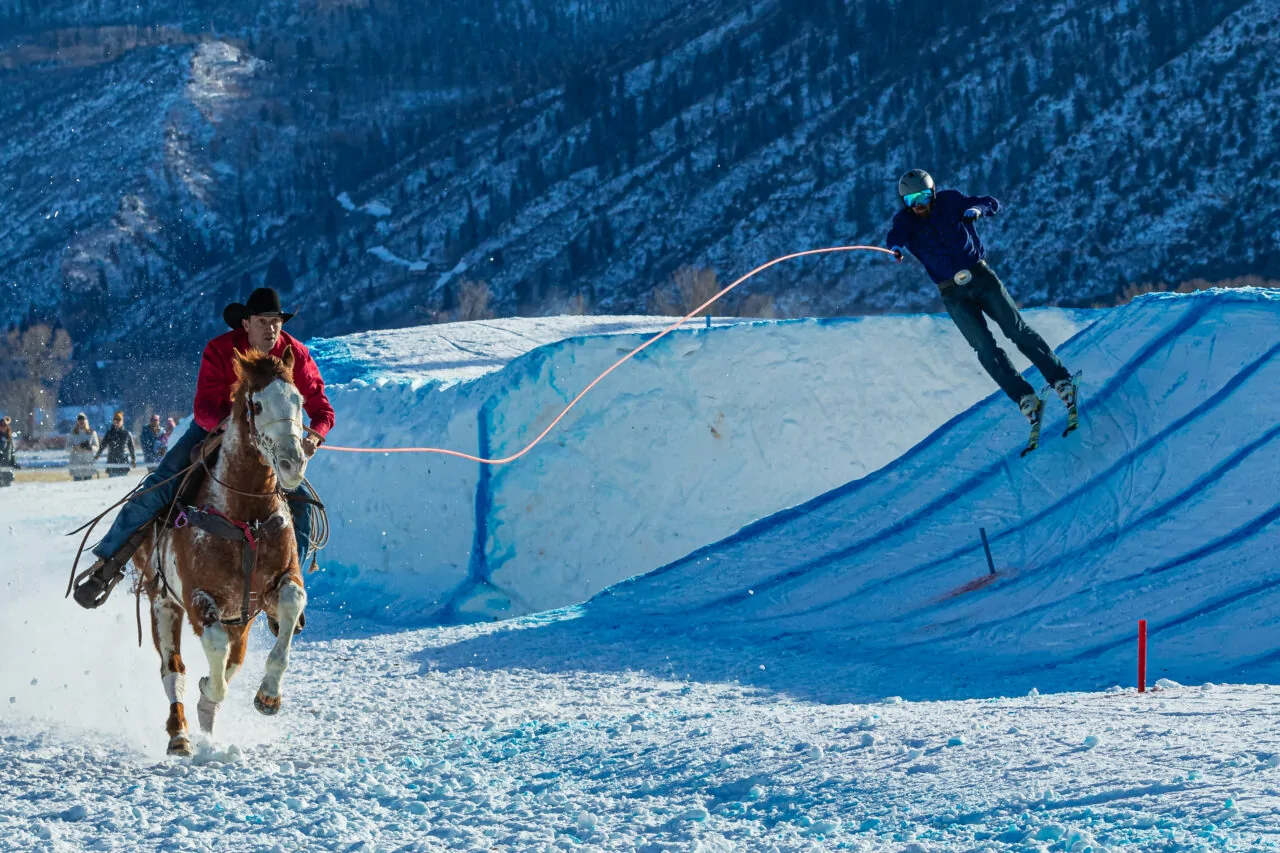
So skijoring is a sport where a horse and rider pull a skier through an obstacle course where the skier has to go over jumps and navigate around gates. And then some courses they have to collect rings on one of their free hands.
Haley Mirr (03:13):
Okay. Very cool. So
Richard Weber (03:14):
It's- Not easy. No, it's not easy. And it's all based off of the time of the skier going through the eyes at the start and the finish.
Haley Mirr (03:24):
Now that we've had a little bit of background on the sport, let's explore some of the towns working to bring the excitement to life. First up, we have Silverton. Silverton hosts one of the most iconic skijoring events in the west, and we were lucky enough to chat with one of the events organizers, Rachel Nichols, about what skijoring means to Silverton and how the town's history and location play a pivotal role in the event success. We'd love to learn a little bit. Before we go into the sport, can you tell me a little bit about Silverton, the town?
Rachel Nichols (03:55):
Yeah, Silverton is an old mining town. It's actually the only town in all of San Juan County. It's got about 450 year round residents, and that number swells to about 2000 in the summertime. In the wintertime, it's a really lean and mean place to live. It's a great old Victorian town. The railroad still runs up there from Durango, so it's a great thing to do in the summertime. Silverton is completely surrounded by mountains. It's one of the only towns that's never burned. I want to say one of the old mining towns, it's never burned. So a lot of the buildings are from the 1800s and early 1900s.
Haley Mirr (04:39):
And how did your community first get involved with skijoring? Has the event evolved over the years or kind of stayed consistent with how it started?
Rachel Nichols (04:48):
Yeah, so it started back in 2010 to a longtime Silverton residence, Pete Masel and Rob Conate started it. And back when it first started, there were just a few teams. We do motorcycle racing and snowboarding events and a lot of different stuff. And as it's grown through the years, it's gotten too large for all of that. So we just do the skijoring now. It is probably the most picturesque setting that you're going to get. It's a really great fast course because it's long. Some of the courses do arena style and they do it in a circle and some of them are straightaways. Us and Leadville, I believe, are straightaway courses and proposed to Springs and Ridgeway arena courses. It runs slightly uphill. So the participants really like it because it's good. It's gentle on their horses. Wow.
Haley Mirr (05:50):
And are you doing it just through that main drag of Silverton?
Rachel Nichols (05:55):
It actually is on notorious Blair Street. It's one street off of the Green Street is a main street. Green Street is the only paid street in town and it's on a dirt road that's one block over. So is a
Haley Mirr (06:07):
Lot of local communities coming to see the skijor is it people from all over that come to see the competition?
Rachel Nichols (06:15):
We get people from all over. We get people that drive down from Montana. And then we have Montana, Wyoming has a lot of skijor people in it. And then we get a lot of the western half of Colorado is a big skijoring event. I'm sure you're Pagosa Springs, Leadville, Ridgeway all have their own skijoring events. So we get a lot of the Western Colorado people for our events.
Haley Mirr (06:49):
And what should first time spectators expect? Anything surprising or unique when you're coming out to see the competition in Silverton?
Rachel Nichols (06:57):
It's a great time for families. It's a great time for people that have never seen skijoring before. It's a great time for people that are skiers and horseback riders. They get a kick out of watching it. There's a lot of people that have never heard of skijoring before that come up from Durango for the first time to watch it and they get a real big kick out of watching the horses and the riders.
Haley Mirr (07:18):
Well, Rachel, I'd love to know how is ski drowing ran up at Silverton? Is it kind of an organization, nonprofit? How can people get involved?
Rachel Nichols (07:30):
It's been a nonprofit status since 2019. It's run 100% by volunteers and that includes everyone on the board of directors. Nobody gets paid a dime to do anything with skijor. We all do it. It's labor of love for all of us. I personally have been involved with skijor for about six years from when I lived in the town to now I just drive back every year to help participate. And we're always looking for volunteers and donations.
Haley Mirr (08:00):
What are the dates for your skijor competition?
Rachel Nichols (08:00):
This year, well, 2026, it's going to be February 14th and February 15th. It's always over President's Day weekend, so people have more time to travel, and so we can make sure that we have enough snow. Last year, we didn't actually get any major snow until that Thursday before ski during. Was the first big snowstorm we got last year.
Haley Mirr (08:28):
I'm hoping that you guys have an incredible turnout. You guys get enough snow. So it seems like we're getting enough of a snow pack up there to make February 14th happen, but it sounds like an incredible event and they're lucky to have you on the board up there as someone who cares so much about ski during in Silverton. So thank you so much for being on the show and I look forward to coming to one of the competitions coming up. We hope you can come up this year. Thanks, Rachel. From Silverton, we're heading to Ridgeway, where this competition really starts to heat up. Richard Weber, one of the founders of San Juan skijor, joined us from his ranch to talk about what it takes to run a high level event while keeping horses, riders, and skiers front of mind. And what is it about ski drowing that's important to your community of Ridgeway in particular?
Richard Weber (09:20):
There's so many different things. What ski during is brought to Ridgeway and Euray County, we bring over 5,000 people to town. It's now one of the biggest weekends in our town and our community. We're bringing all these people to town and then we also give back to the local youth. We're doing $5,000 scholarship every year. I mean, there's so many benefits to skijoring coming to town.
Haley Mirr (09:44):
And what makes the … Because I know there's skijoring that kind of happens all over the west. What is unique to the competition at Ridgeway when compared to some of the other competitions that are out there?
Richard Weber (09:59):
Ridgeway is just so unique in so many different ways. Tyler Smedsrood, he's our course designer and a track builder. He has brought so many things to ski during that has never been done anywhere else. Until 2017, you never would see two different size jumps on a roundtrack. San Juan ski drink brought that in where we have big jumps for our open division and smaller jumps for our sport or novice. So Tyler did that and then Tyler decided, “Well, let's do a gap jump. Let's jump a pickup.” So then we got Toyota to sponsor us. They gave us a truck and now we jump a Toyota truck this year. And now we also have Subaru giving us a vehicle that we're going to jump as well. So when somebody says that something can't be done in ski during, we just say, “Hold your beer and watch this, ” and we show them wrong.
(10:51):
So there's nothing that we won't try. We've been very fortunate. We haven't had any serious injuries and a lot of that comes into Tyler puts so much time into his track building for the … So we do build really, really rowdy features, but when he's building it, he's always thinking about how to try and keep the skiers as safe as possible and building certain features that help with that. And then that comes right down to the footing for the horses. The footing for the horses at San Juan ski during has always been known for probably some of the best footing on the circuit, if not the best. Our main goal at this race is to keep all of the horses upright and not have any horse injuries. And we have done very, very well at liding up to that.
Haley Mirr (11:46):
For the laymans that are on listening, when you talk about footing, what does that really mean when it comes to horses?
Richard Weber (11:55):
Yeah. So do you think let's relate this back to barrel racing. In barrel racing, you have all this footing that's hauled in and it's sand. And after five or 10 runs, you can go out there and you can smooth it out with the tractor and you can make it pristine again. Well, in ski during, you can't do that. You have this snow that's frozen and you want to preserve this snow for as long as possible. So it's a really difficult task to try and do it right. You have to put a lot of moisture into the snow, which you do by adding water. And you want to keep it hard, but once it falls apart and once it gets down to sugar or to mush, you can't fix it. You're kind of just stuck with that. And so really knowing how to keep your footing good is awesome.
(12:44):
It really is. I mean, it's tough though. We battle every year and we learn things every year and we'll work all night long for a week if we have to. We'll never go to bed if that means that's what it takes to keep the footing good for the horses.
Haley Mirr (12:58):
What are some of the prizes that competitors can win on the circuit of skijoring?
Richard Weber (13:04):
Yeah. So most of it's, there's belt buckles and coats and then there's cash money too. Ridgeway is known for … We've had the biggest purse in the country for the last nine years. And last year we gave out right at $50,000 in prize money over three days. So if you're one of the competitors in the open division and you have a really good weekend, you can walk away with six to eight grand if you had a great
Haley Mirr (13:29):
Weekend. What is it about Ridgeway that makes it different than some of the other kind of mountain towns? Other than the ski drain, obviously, why do people come and visit Ridgeway?
Richard Weber (13:38):
Ridgeway is super unique. We have a mining background. We have ranching background. Tons of people come out for hunting in the fall. There's a lot of Alpine trails up in the mountains where people go four wheeling throughout the summer. So yeah, there's just people coming here year round, whether it's ski during or ice climbing. I mean, there's so many things to do in Ridgeway. Telluride's only an hour away. They go skiing on the slopes. There's a lot of things that you can do if you're in Ridgeway with only traveling 30 minutes to an hour.
Haley Mirr (14:08):
That's amazing. And for those same visitors who are coming to visit who've never been to the ski during at Ridgeway, what is the must see or must do moment during the San Juan ski drowing competition?
Richard Weber (14:22):
Pretty much all of it, honestly, from when the gates open to the end, we have our gap jump where the skiers have to jump over a Subaru and a Toyota this year. The Gap Jump is our highlight. It starts at two o'clock both days, but just the whole event. San Juan is known as putting on the most elite race in the country. We have the best competition. We have the most money. We bring in the highest level of production into our race than any other race. We have two umbotrons. We have seven different cameras. We have three on the track, one in our announcer's booth. We have a camera at the start doing interviews. We have a jumbotron doing … Or I'm sorry, we have a drone filming and do an instant replay from the drone. We have booth reviews on our run. Wow. Not only do we have the toughest competition, but we have brought in the highest level of production compared to any other race in the country.
(15:21):
So it's just like an elite race. There's a lot of other really, really good races out there, but maybe they don't have as much production that they've brought in, but that doesn't mean that they don't put on a good race. Maybe they have a smaller town, but they still put on great races. San Juan just really tries to step it up as much as we can. And our motto is racing the bar since 2017. And we do that every single year. This year, we will have seven different bands playing throughout the weekend. During the event, we have bands, we have a party tent going, we have a mechanical bull. We have instant replay. I mean, we got everything. There's nothing-
Haley Mirr (16:06):
I was going to say you have it all. Sounds like flight to production. So where is the track happening? Is it in town? Is it on a ranch? Where do people go to see the ski drain?
Richard Weber (16:17):
It's right in town at the fairgrounds.
Haley Mirr (16:19):
Okay. Amazing. And what date? When is all of this happening this winter if we get more snow?
Richard Weber (16:25):
Oh, we'll make snow. So snow's not an issue. Go ahead.
Haley Mirr (16:29):
We're good.
Richard Weber (16:30):
Yeah, San Juan Skijor is definitely happening. So we'll be right at the fairgrounds and it'll be January 9th is our novice during the day from 10:00 to about 2:00. And in this year we've added a Friday night lights. So we will run our open pro division under lights Friday night. Wow. That just goes back to raising the bar. Every year we're doing something new. And then Saturday and Sunday, we'll race from about 10:00 to 4:00.
Haley Mirr (16:57):
Well, thank you, Richard, so much for taking the time. I know as a rancher and as a coordinator of an event that's coming up, you have a lot going on. So I really appreciate you taking the time to do this with us today. And if people have questions, we will make sure that they reach out to you, Richard, those listening. And for those listening, January 9th, it sounds like the place to be. Make sure you don't miss out.
Richard Weber (17:21):
Yeah, sounds great. People can get ahold of us on our email, sanjuanskijuring@gmail.com or on Facebook, Instagram. And yeah, I mean, if you want to come out and have an awesome weekend with your family, San Juan ski during, it's where you want to be.
Haley Mirr (17:36):
Awesome. Well, thank you, Richard, for taking the time today, and I hope to see you soon.
Richard Weber (17:40):
Awesome. Thank you so much.
Haley Mirr (17:45):
And for our last look, we're moving away from the mountains and into the front range with Kevin Venice, the race director of Estes Park skijoring. Kevin chatted with us about what skijoring looks like in Estes Park and how accessibility, infrastructure, and community have helped create an event that everyone can watch and participate in. Tell us a little bit about the Estes Park ski drawer. Kind of what makes it different from other towns? What is a big draw for a lot of people and maybe even what's kind of your regional draw? I know you guys are close to Boulder, but winter is a little bit different for some of that.
Kevin Benes (18:17):
Yeah. The big thing about our skijoring event is every track is different. Every competition is unique. You've got Leadville, which is the raw straightaway down Main Street. You've got Ridgeway, which is the horseshoe. Ours has a turn in it, but the main draw of us is that we're very close to the front range. We're by far the close to skijort event to Denver, Boulder, that entire area. And so what that ends up being for our event is we are the spectator event. We draw about 10,000 people over the weekend and roaring crowds the entire … The other part about our event that makes a big difference, we're not in a town. We're on our fairgrounds. So we have not only that, we have a warming hut, we do carnival games, we do food trucks, we do just a lot of different things that really make it more of just than the competition, but we are trying to be the spectator friendly one because we realize that a lot of our visitors come from the front range to check out a sport.
(19:17):
And most of our people, we do surveys. Last year, 80% of people who came to our event had never been to a skijor event before. So tons of first timers. That's amazing. Whereas a lot of the ones that are much harder to get to, it's the diehards. It's people like me that have been to 30 skijors that are going to theirs, that are going to every single one they can. Our first year we sold out. We did Saturday, Sunday last year, and we sold out both days. And this year we'll be adding Friday night. So we'll be having lights. And so our novice will compete on Friday night, and then we'll run Saturday, Sunday for our open sport and snowboard. Open and sport, as you probably have heard from some of the others, those are the different levels of competitors. Open being the professionals, sport being the people who are experienced, but not quite ready to go to that open level.
(20:00):
I fall somewhere more on that sport level. And that's what we put on our Saturday, Sunday. So yeah, we expect to sell out crowds every day.
Haley Mirr (20:09):
That's amazing. And what kind of differentiates you? We spoke a little bit before starting to record, but what makes your competition a little bit different than some of these other towns out west that might be a little bit further away?
Kevin Benes (20:23):
So we're built for it. We have the hotels, we have the restaurants, we have the infrastructure around bringing these people to town. The other nice advantage is Estes Park doesn't have a ski resort. So it's a very affordable place to come to in January. Probably one of the last places in the world you could come to an event like this and get a hotel room for under a hundred bucks a night and be able to come to our event.
Haley Mirr (20:44):
How does the community of Estes kind of rally together for this event?
Kevin Benes (20:48):
I get more support for this event than all my other events combined for many reasons. Number one, a lot of our locals compete. The novice division is almost all Estes Park locals. There's a big horse community in Estes, a lot of stables. Rocky Mountain National Park is a very horse-friendly national park. So there's a lot of … If you were to come here during summer, one of the number one things to do in Estes Park is go horseback riding. So there's a lot of horses here. There's probably just as many horses as there are humans around this area. And so it's a big equestrian area. So a lot of people like me that love to go ski and a lot of people that own horses. And one of the coolest things about this event last year was connecting those people. So it was really interesting.
(21:31):
My co-race director, Holly, she's more of our horse lead and I'm the ski guy. And it was last year when we were trying to fill, we weren't sure who was going to sign up and we were trying to rally all of our friends. And so she recruited everybody she knows with horses. And I recruited everybody I know without skis and we just connected each other. And you'd be surprised even in this small town, those two groups didn't really know each other all that well. But this sport really brought us all together. And I think that's one of the fun things about skijoring and why it has taken off so much in Colorado.
Haley Mirr (22:00):
Yeah. I feel like that's what makes Colorado so special is you do have that still and they all kind of work together. I'd love to know a little bit more about your novice category. How do you guys make that accessible to kids? How do you make accessible to people that have maybe never done the competition before? And how do people prepare for that?
Kevin Benes (22:20):
Yeah. So our novice is all Friday. So Friday is what we call novice night. We allow 50 teams to compete and no experience necessary. In fact, no experience preferred. If you have some experience, we'd rather you move into sport. It doesn't take very long to learn how to do this sport. If you can ski a blue, you can ski skijor. No problem. And that's one of the things that I think it looks very intimidating. It does. But it turns out it's way … As somebody who's relatively new to competing and I've now competed quite a few times, it's way easier than you think. It's amazing. You grab that rope and hold on and the first five seconds is the most terrifying thing you've ever done. And then you take your first turn and you're like, oh, I got this. And so that's novice night.
(23:12):
I could look up the statistics, but usually it's 80 to 90% of people on a novice night have never done this before. And really similar numbers for locals. The hardest part is getting those people who have done novice a couple times to move them into sport. And then your second … So novice night is just kind of crazy. It's always a little bit slower, a little bit more chaos at the starting gate of people just kind of figuring out how to get started and getting the horses lined up and getting the rope in the skier's hand and getting them going in the fall starts. That's really all part of the fun of novice. And then the second question you asked was on youth. We do our youth a little different. We run our youth on Saturday, Sunday in the main show. So our youth is free.
(23:53):
We allow 12 teams per day for youth. And if you're under the age of 14, you can be towed by an adult, but you can't compete, but you both must be under the age of 14 to compete and win. And our youths … Last year, our youth winning team on Saturday was faster than any novice team. They were a 12-year-old skier and a 14-year-old Bale riding girl, and they were just lightning fast.
Haley Mirr (24:21):
That's so fun.
Kevin Benes (24:22):
Watching the kids do it. And then we have kids as young as my son will be five, and we'll tow him behind a quarter horse.
Haley Mirr (24:30):
That's so fun. Well, I love it too, because kids have no fear. So it's probably why they're even better. I wouldn't be great out there. So where do you see skijoring headed in the next couple years? It sounds like it's already gone gangbusters and even in the last five years has taken off to where it is today. Where do you kind of see it headed?
Kevin Benes (24:51):
I see it going nowhere but up just especially being kind of new to this sport and being in sports that have stabilized. And even I've been in sports that have kind of died off over the years, I've never seen the amount of enthusiasm that I have for something like skijor. It's pretty obvious to see why. It's so engaging. And if you stand on the sidelines and watch it happen, it is just constant. Every three minutes, there's the most exciting thing you've ever seen in your entire life happening. And when the horses are really going fast, especially in the open, you can feel the ground shake. You're getting sprayed with snow. It's just a really exciting sport, especially for spectators. And as somebody who skis, it's amazing how accessible it is to do. And you think it's really hard and it's just if you have the little bit of courage to grab the rope, it's really not that difficult to get started.
(25:43):
What the pros do is a whole nother level, but just the ability to get to the finished gate still on your feet is just so doable. And the final thing Skijor has going for it is the social media world we live in. It is so engaging. It's amazing what that content does online. People just seem drawn to it.
Haley Mirr (26:03):
I don't think we've mentioned, but what dates is ski during this year?
Kevin Benes (26:07):
Yep. January 23rd, 24th, and 25th.
Haley Mirr (26:10):
Well, thank you so much for coming on our podcast. It's just been amazing to hear about what skijoring is, where it's headed, how it connects people in different communities. And I'm just excited to see where you guys go with all of this.
Kevin Benes (26:22):
Yeah. Thank you so much for having me.
Haley Mirr (26:23):
While all of these events differ, the core goal remains the same. skijoring is more than just a fun winter spectacle. It's a way to support small towns during the off season and create a space where ranching and recreation can meet. In many ways, the rise in popularity of skijoring reflects the resilience of our western culture, finding new ways to celebrate tradition while keeping communities vibrant and functioning year round. From the historic streets of Silverton to Ridgeway's high energy production and Estes Park's accessibility, skijoring is growing and shows no signs of slowing down. If you're looking for a uniquely Western winter experience, these events are worth seeing in person. We'll include links and dates to each race in the show notes, and we'll hope to see you out in the slopes. Until next time.
Thanks for joining us today. To learn more about the ranch real estate market or our ranch marketing process, make sure to subscribe to our newsletter on our website at mirranchgroup.com or give us a call at 303-623-4545. See you next time.